One of the biggest advantages of Emergent Vision Technologies‘ EF mount cameras was never purely mechanical, nor simply about attaching high-quality photo lenses. The real differentiator has always been full electronic lens control directly through the eCapture Pro or eSDK Pro software. Being able to control focus and aperture in software is a major advantage for any application that needs to track a target dynamically. This is well known in sports, broadcast, and entertainment environments. The same requirement is becoming increasingly important in industrial and scientific applications.
A good example is robot-guided inspection or part handling. Parts often arrive with differences in position, height, or orientation. Instead of stopping the process or relying on a large depth of field with reduced image quality, systems can adjust focus in real time based on feedback from vision or motion data. Similar challenges exist in logistics automation, automated warehousing, battery inspection, and test rigs where products move at high speed and exact positioning cannot be guaranteed. In all these cases, lens control becomes part of the control loop rather than a static setup parameter.
EF Lenses are End-of-Life
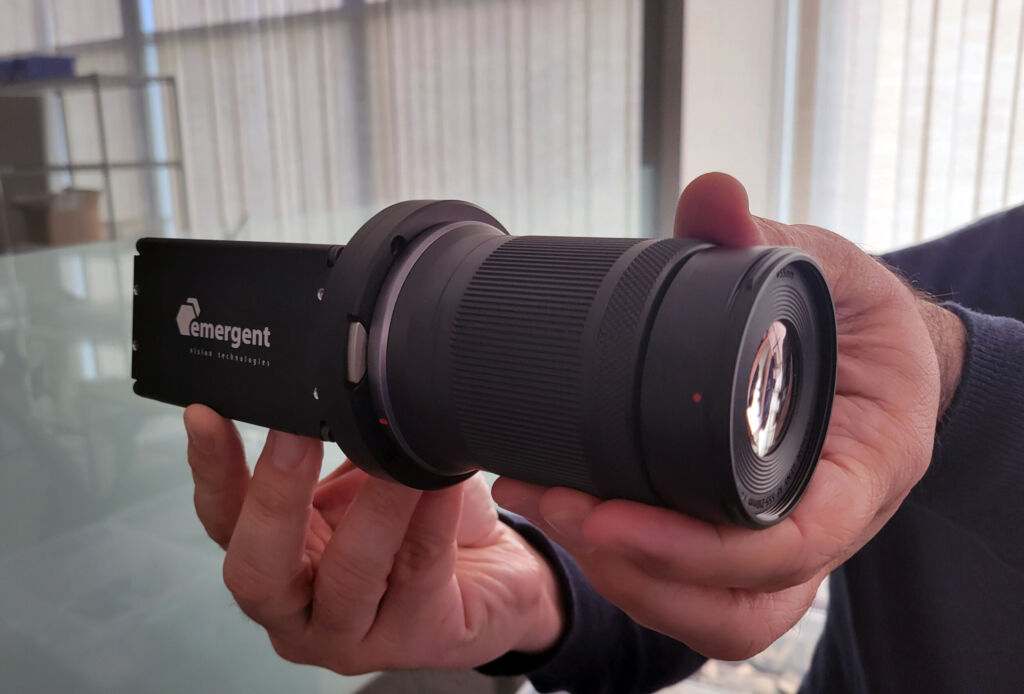
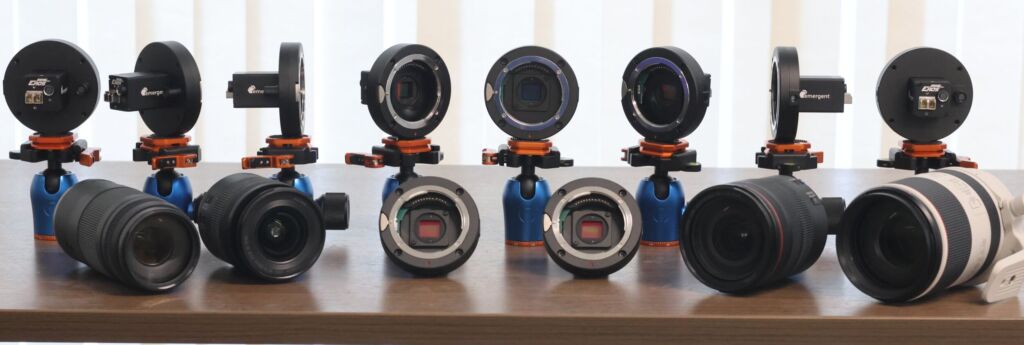
EF mounts have served these applications well for many years. The lens ecosystem is large, mature, and optically strong. However, EF has been officially discontinued by Canon, and long-term availability is no longer guaranteed. Its successor, the RF mount, is designed specifically for modern high-resolution sensors and demanding optical performance. As RF lenses increasingly replace EF in professional imaging, continuing with a discontinued interface limits future system designs and risks long-term investments in vision. That is why Emergent has released its native RF mount. The new RF mount implementation was designed in cooperation with Canon, ensuring electrical compatibility, mechanical stability, and proper system integration. This is a native solution, not an adapter-based workaround. In fact, Emergent was the first camera manufacturer to bring RF mount to high-speed GigE Vision cameras, well ahead of broader market adoption. OptoMedias ultrakompaktes Mini SFF bringt zuverlässige, schnelle Glasfaserverbindungen in Industriekameras der nächsten Generation. ‣ weiterlesen
Fiber Mini SFF für GigE Vision
RF Mounts designed for High-Speed
Canon RF mounts offer clear technical advantages over legacy mounts. A large throat diameter combined with a short flange distance enables lens designs with higher light efficiency and improved edge-to-edge sharpness. These benefits are particularly relevant for large-format sensors with high pixel counts. In high-speed imaging, this directly translates into shorter exposure times, higher usable frame rates, and more reliable image quality across the full sensor. There is simply less optical compromise.
Software Control is the Key
Moving from EF to RF does not mean giving up what made EF mount so powerful. Lens control remains fully integrated into Emergent’s software ecosystem. Focus, aperture, and zoom control are available today, allowing systems to dynamically adapt not only sharpness but also field of view. This is particularly useful for applications such as automated tracking, flexible inspection lines, and volumetric capture setups where objects of different sizes must be handled by the same camera system. Instead of physically reconfiguring optics, system behavior can be defined in software.
Bridging Two Imaging Worlds
The RF lens mount is well established in broadcast and cinema environments. By bringing it into the world of high-speed GigE Vision cameras, Emergent bridges two traditionally separate ecosystems. Users gain access to the modern, high-quality RF lens portfolio while maintaining deterministic Ethernet-based data transfer, precise synchronization, and proven multi-camera scalability. Users are not locked into a single vendor or an end-of-life interface. Optics, electronics, and software are aligned for high-speed performance with RF lenses.
Summary
The move from EF to RF is not about following trends. It is a direct response to how imaging systems are used today. Lens mounts may appear to be small components. In reality, they define system flexibility, optical performance, and long-term viability. With native RF mount support, Emergent Vision Technologies removes another limitation from the high-speed imaging chain and keeps control exactly where it belongs: in software.