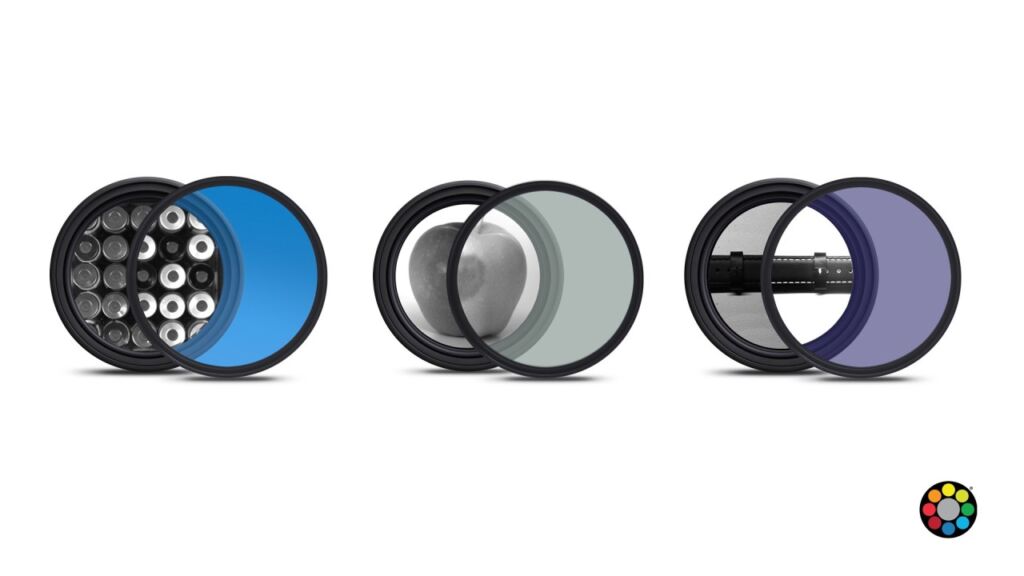
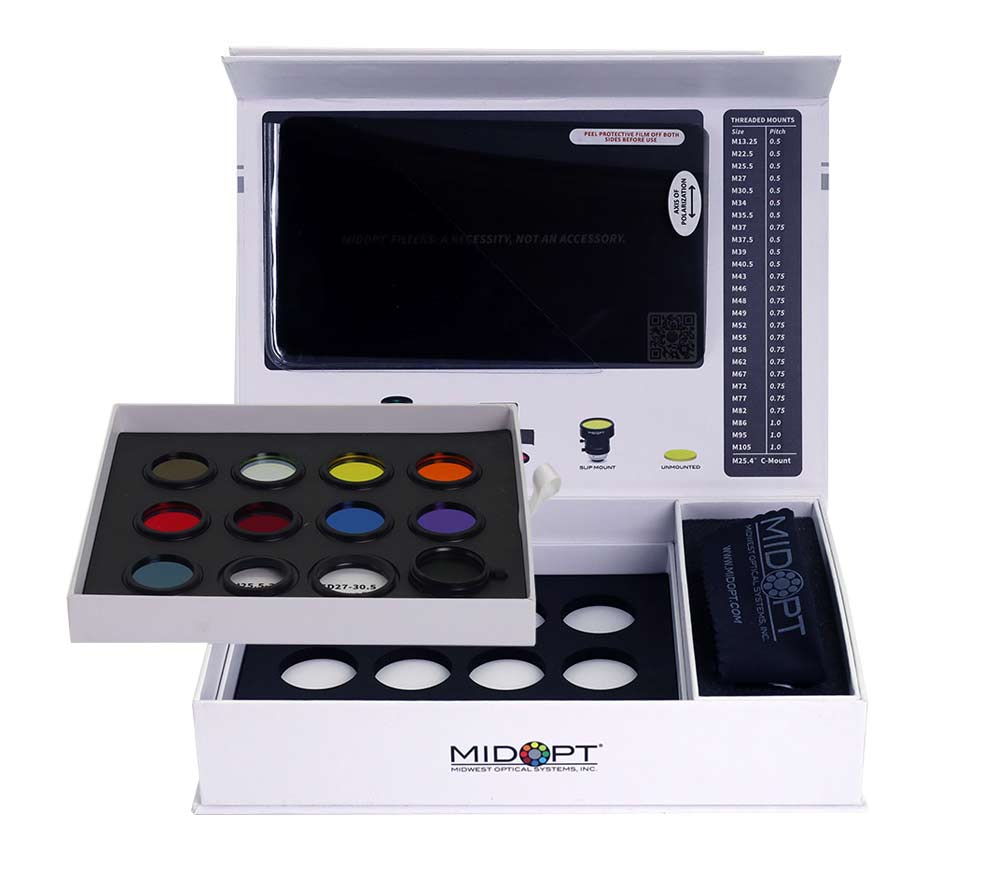
Relative to lighting equipment, optical filters are far less expensive, easier to obtain, and can produce significantly better results. In many cases, it makes sense to test optical filters before ordering lighting hardware. However, many are unsure what the best filter for their system may be or where to begin. Instead of testing different colors of LED lighting, placing a filter in front of the camera lens provides a quick way to determine whether a desired effect will occur. Bandpass filters are designed to emulate the output of the most commonly used LED wavelengths in machine vision. By using white light and a bandpass filter, you can easily determine the proper wavelength for your application. We recommend starting with a machine vision filter kit such as the MidOpt FK20, which includes the ten most often recommended UV, visible (VIS) and NIR machine vision filters. The filters come assembled in a 27mm filter mount, and the kit includes a M25.5 and M30.5 step adapter to accommodate the three most common lens filter mount sizes.
Filter Types
In color applications, complementary colors form the most dynamic contrasts. The same is true when monochrome cameras are used. But when using color filters, results are seen in black, white and varying shades of gray. Optimum contrast between two subjects can provide a very white and very black hue within the same scene, accomplished by maximizing the amount of light transmitted in at least one wavelength range and minimizing the amount transmitted, or attenuated, in another range. For example, to brighten or highlight a subject that is predominantly blue, transmission in the blue portion of the spectrum must be maximized, and the green, yellow, red and other portions of the spectrum blocked. Color filters attenuate light within a portion of the VIS spectrum and have an obvious color. These filters can be categorized as shortpass, longpass and bandpass filters.
Shortpass, Longpass & Bandpass Filters
Shortpass filters pass shorter wavelengths of light, while blocking longer wavelengths. Longpass filters do the opposite, passing longer wavelengths and blocking shorter wavelengths. These filters are usually identified by their 50 percent points, the point where 50 percent of the light is being transmitted and 50 percent is being blocked – a halfway point in the transition from blocking to transmitting, or vice versa. A red 630nm longpass filter, like LP630, may be a great choice for applications using a 660nm LED or structured laser diode lighting. It blocks lower wavelength light, has a 50 percent point at 630nm and has very high transmission at 660nm and beyond. The LP630 filter would not be suitable for use with 630nm LEDs.
In order to achieve maximum contrast, 100 percent transmission at 660nm is desirable, while most of the ambient light should be completely blocked, with as sharp of a cut-on and cut-off as possible. To the human eye, the LP630 may appear to be a good filter choice, but most CCD/CMOS cameras have excellent NIR sensitivity, and considerable near-UV sensitivity as well. Many of these cameras have sensitivity that peaks in the NIR. When a graphic representation of a typical CCD/CMOS spec-tral response curve is superimposed on the filter’s transmission curve, we can see that the LP630 does not block as much of the light to the camera as one might imagine. Slightly more than half of the extraneous light that the camera is sensitive to is being blocked. Because of this, MidOpt recommends using a broad bandpass filter for these types of applications, such as the BP660 filter.
Bandpass filters are named according to the central or peak wavelength it transmits and will block longer and shorter wavelengths, resulting in improved contrast and better control over changes that may occur over time in ambient lighting conditions. For bandpass filters, broad is necessary in most machine vision applications because this allows for variations in the spectral characteristics of the LEDs or laser diodes. When choosing a bandpass filter for a vision application, it’s important to choose one that’s stable (less sensitive to angle of incidence), consistent in performance and one that utilizes premium anti-reflection coatings to maximize the amount of transmission entering the vision system. All MidOpt bandpass filters have a hard, multi-layer anti-reflection coating that is optimized for the wavelength it’s intended for. They are designed with StableEdge technol-ogy to lessen the effect of angle of incidence, and their passband is Gaussian shaped to emulate the output of the LED.
Polarizing Filters
Light reflected from a non-metallic surface such as glass, lacquer, plastic or liquid results in polarization of the reflected light. Polarized reflected light can be the result of uncontrolled ambient light, but is more often from the light source. As the angle of incidence of the light and the camera relative to the subject are about the same and approach 55° to normal, a glare and loss of contrast becomes more pronounced. In sit-uations where the subject is partially obscured by this unwanted reflection, using a polarizing filter can reduce or eliminate this problem. Polarizing filters can also highlight stress patterns in clear plastic or glass to determine whether glass has been properly tempered.












![Die [me] – mechatronik & engineering wird digital](https://cdn.tedo.be/tedo-mu/wp_uploads/sites/10/2026/03/Unbenannt.jpeg)