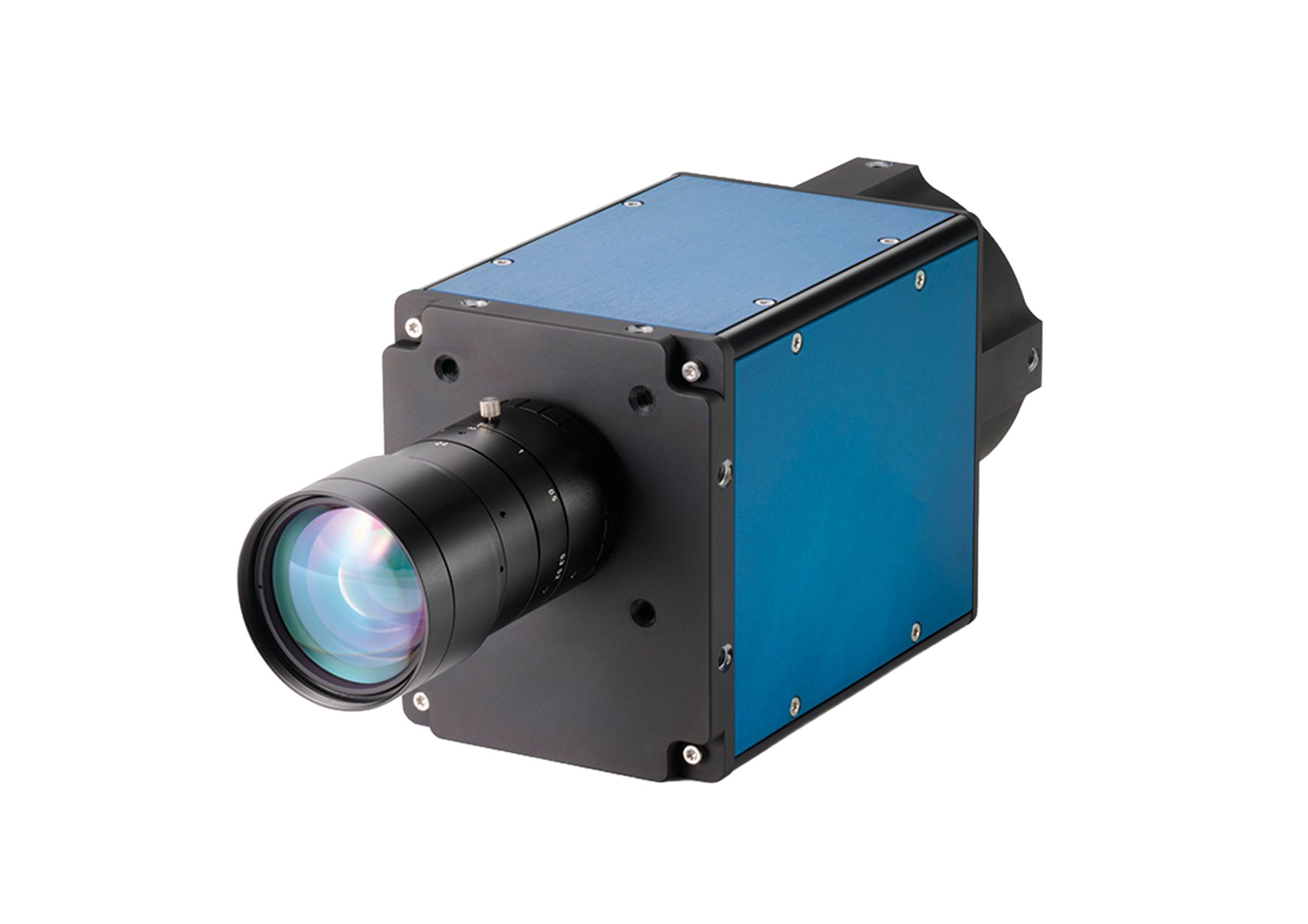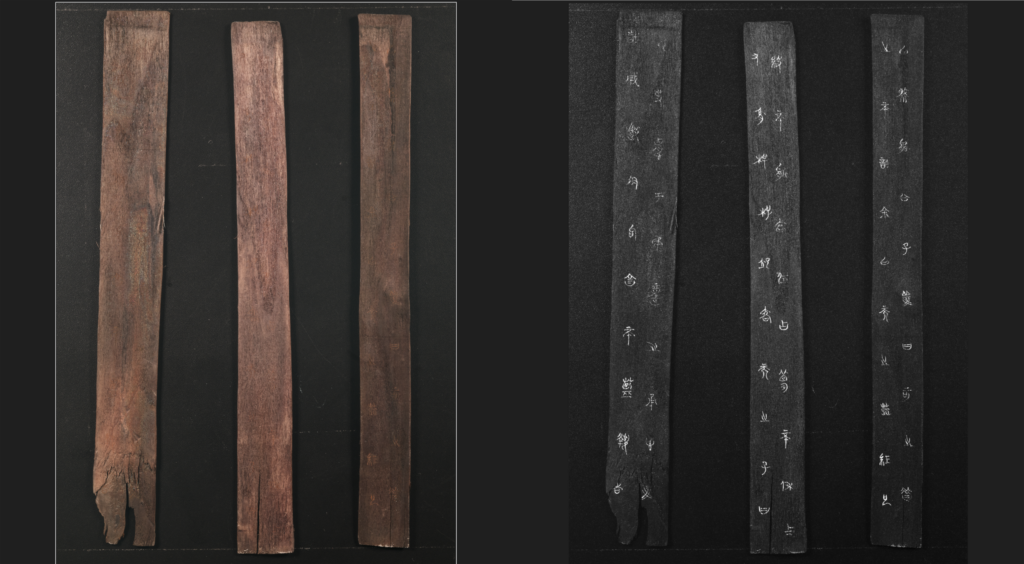
The Western Zhou Dynasty, spanning the early-to-mid first millennium B.C.. Its written records allowing researchers to study the social structure, political system, cultural customs, and other aspects of that time. Written on thin strips of catalpa wood in red-orange vermilion, the characters once stood out starkly on the darker surface of the wood. Due to the ravages of environmental factors through the passage of time, the handwriting on the surface of the wooden slips has become difficult to identify. Faint traces can be seen with high-definition visible light capture, but they cannot be identified. Vermilion is made from cinnabar, a form of mercury sulfide. The spectral characteristics of cinnabar under IR and UV light are not pronounced. In such cases, images must be captured across the entire spectrum, followed by spectral analysis, interpretation, and annotation. Phase One Multi Spectral Imaging (MSI) is a precise collection method that helps capture the differences in reflection characteristics of different materials at various wavelengths. To quickly and easily produce images of the surface of the wooden strips, the Chinese researchers used MSI narrowband imaging with the Phase One Rainbow MSI Solution. Throughout the imaging process, there was no need for refocusing, re-alignment, or exposure correction for different spectral bands, as this is all fully automated in the MSI software. This can provide efficiency savings of up to 50 times compared to previous technologies. The MSI solution can capture high-quality spectral information from 16 individual wavebands within the 365-940nm range. The analysis tools built into the software, including Principal Component Analysis (PCA), Independent Component Analysis (ICA), and K-means Clustering, facilitate the immediate analysis of the narrowband image stacks, allowing researchers to find high-dimensional imaging results with significant contrast and difference for direct interpretation. Through PCA, the high-dimensional spectral data is reduced to several principal components, which can represent most of the information in the original data. After dimensionality reduction, the spectral feature differences between the handwriting and the background wood can be more easily identified. Based on the results of PCA analysis combined with advanced image processing algorithms, the blurred handwriting contours are gradually restored.
www.phaseone.com