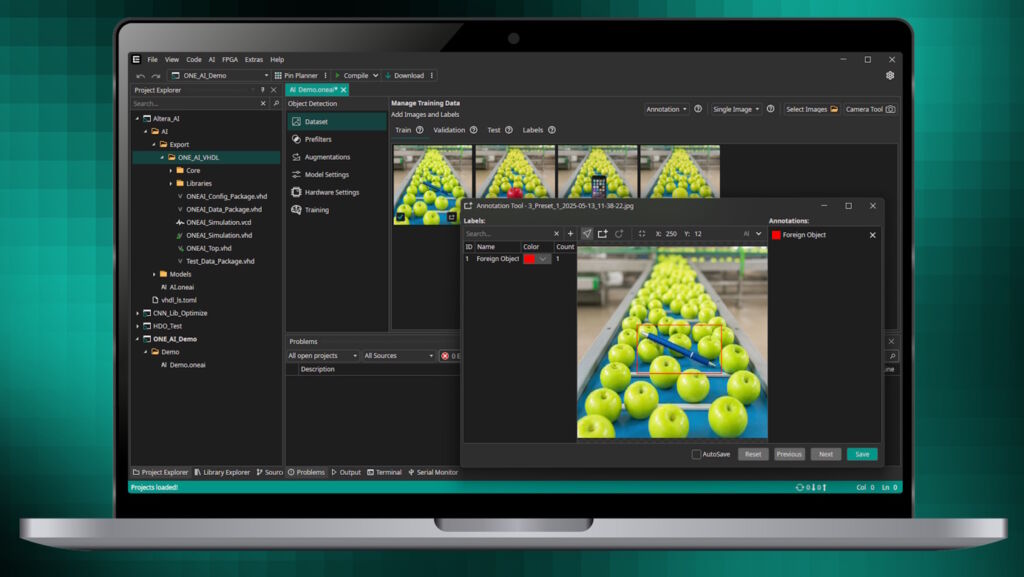
Current Edge AI approaches complex. Optimizing neural networks for FPGAs requires deep expertise in both AI and hardware design. Many software tools promise quick deployment, but their generic prebuilt models cannot handle the diversity of real-world devices and requirements. Achieving top performance usually means long development cycles and high costs. The more precisely an AI is optimized, the more expert knowledge and experimentation it demands. Most companies compromise: they deploy inefficient models that consume too much power and yield mediocre results. The bottleneck is the lack of accessible AI optimization without expert intervention. One Ware resolves this dilemma with its patent-pending One AI platform, the world’s first solution that automatically generates custom neural network architectures optimized for each dataset, application, and hardware target. It automates the process in three steps:
- Analysis: It examines the dataset, application, and hardware specifications (FPGAs or SoCs included).
- Prediction: Using AI research and prior optimization data, it predicts ideal architecture properties in One step.
- Generation: It then assembles the architecture automatically in just 0.7 seconds.
By combining the prior knowledge, One AI delivers AI-architectures, that often outperform manually designed models without trial and error. The user-friendly platform makes AI development accessible even to non-experts. After architecture prediction, users can train and export models optimized for their chosen hardware. One Ware Studio, an open-source development environment, completes the ecosystem: One AI handles automatic model design, while One Ware Studio bridges to hardware deployment.
First Universal Solution for AI on FPGAs
Integrating AI into FPGAs has long been difficult. Existing manufacturer tools rarely exploit the full potential of the hardware and often rely on hybrid setups using processors plus FPGA accelerators, adding overhead and complexity. One Ware’s solution is manufacturer independent. Alongside its optimization platform, the company offers open-source HDL libraries enabling AI to run even on small FPGAs. As in traditional image processing, data is streamed pixel by pixel through parallel FPGA layers until the result emerges. The generated HDL integrates seamlessly with any FPGA and avoids extra processors or RAM buffers, minimizing latency and maximizing performance. This fully parallel method works best for efficient architectures like those usually produced by One AI. But for complex applications, the company can also generate and export larger models that still benefit from combined FPGA-CPU designs and can be integrated with the vendor tools.
FPGA-based Potato Chip Quality Control
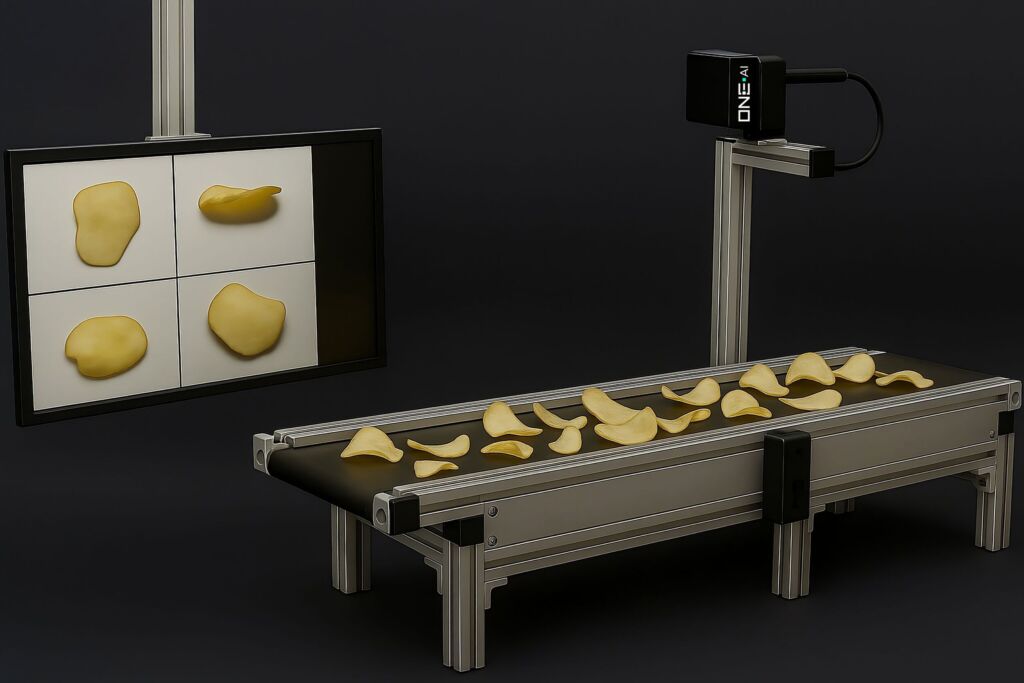
A joint white paper by One Ware and Altera demonstrates the difference. In a potato chip inspection project, a universal AI achieved 88 percent accuracy and required a Jetson Orin Nano to process 24 chips per second, which is too slow and power-hungry for industry needs. One AI changes this: within 0.7 seconds, it generated an architecture achieving 99.5 percent accuracy and 1,400 times higher efficiency. So even on a ten-year-old Altera MAX10 FPGA, inspection speeds could be increased to 1,700 chips per second, while consuming 20 times less energy and cutting latency by a factor of 488. This proves that the right architecture matters more than high-end hardware. With One AI, efficient models run on affordable, legacy systems, making advanced AI feasible for real-world factories. The project and set-up instructions are available on the homepage, allowing users to replicate the example and train their first model within minutes.
Economic Perspective
Choosing efficient AI solutions now also makes sense from a business standpoint. With One AI, costs usually only occur once a company decides to implement a working AI model and needs a commercial license. This removes the need for high upfront investment and is far cheaper than conventional AI development, even including license costs.






![Die [me] – mechatronik & engineering wird digital](https://cdn.tedo.be/tedo-mu/wp_uploads/sites/10/2026/03/Unbenannt.jpeg)