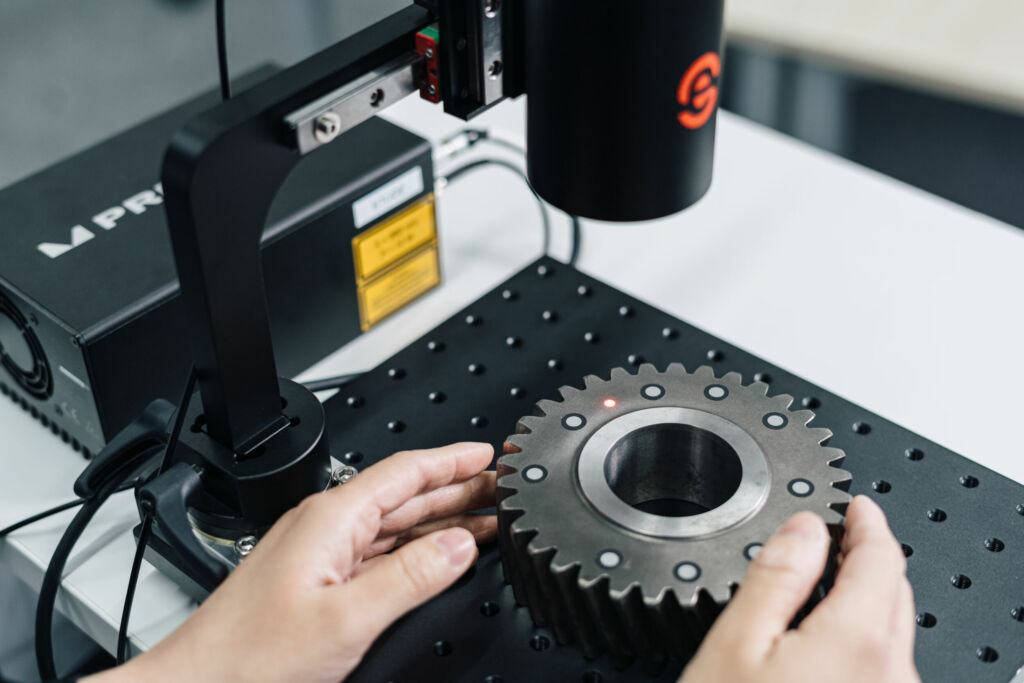
For applications in the automotive and other industries, Precitec’s Enovasense Point Sensor provides a reliable solution for measuring the thickness of dry or wet/uncured coatings, such as paints, lacquers, metallic, ceramic, or organic layers, inks, varnishes, enamels, resins, and adhesives – regardless of the substrate on which the coatings have been applied. Here, too, precise measurements in the µm-mm range are possible whatever the object’s curvature, shape, edges or surface structure. The Point Sensor is compact, light, maintenance-free and insensitive to vibration. In view of the compact dimensions of both the Point Sensor and Field Sensor HR, integrating these devices into a production environment poses no problems at all.
Under-surface area analysis
Laser photothermal technology can also detect cracks, defects, delaminations, material changes, or poor adhesion beneath the top layer of virtually any material or coating. The Field Sensor HR will measure an entire surface in a single shot, capturing over 100,000 points in around a second. While measuring shapes, edges, and any kind of curvature and surface structure, its non-contact, non-intrusive, non-radiative technology will quickly detect any kind of under-surface abnormality. The sensor´s software enables any application to be easily configured and trains an algorithm to automatically distinguish between detected defects and the absence of defects.
Laser cladding on brake discs
A highly relevant current example is laser cladding on brake discs. Euro 7, the EU emissions standard agreed in 2024 and due to come into force in 2026, will also apply to non-exhaust emissions, such as particulates from tyres and brakes. For the automotive industry this will mean tough maximum levels for small-particle PM10 emissions in order to reduce the health hazards caused by particulate matter from urban traffic in particular. Diode laser-based hard coatings enable reliable compliance with all specifications and reduce brake dust with a maximum particle size of PM10 by up to 90%.
One of the main ways of achieving Euro 7 compliance is to add a harder layer to the brake disc track. A typical deposition process for this layer is high-speed laser cladding followed by grinding. However, controlling the thickness of this coating over the whole track is essential to ensure that enough of this hard material has been added. Moreover, inspection also enables better monitoring of the stability and homogeneity of the coating and grinding processes. Due to the generally high similarity between the hard layer and the cast-iron base, technologies relying on magnetic or conductive differences between the two materials cannot be used in the majority of cases. For the same reason, radiative techniques such as X-ray fluorescence are incapable of differentiating between the layer and the base substrate.
Laser photothermal technology
Laser photothermal technology, in contrast, offers an effective solution for controlling layer thickness in laser-cladded and thermally sprayed applications. This sensor technology makes non-contact, non-destructive, non-intrusive, non-radiative, fast, repeatable and easy-to-integrate in- or at-line measurement possible in an easy and cost-effective procedure. The entire track surface of brake discs, for example, can be measured with an outstanding level of precision. RMS repeatability levels as low as µm can be obtained on a typical 350µm thick layer. In a study performed in collaboration with Laserline, Precitec was able to perform a full thickness mapping of four brake disc sections with various thickness levels of 316L stainless steel with titanium carbides on the cast-iron substrate.
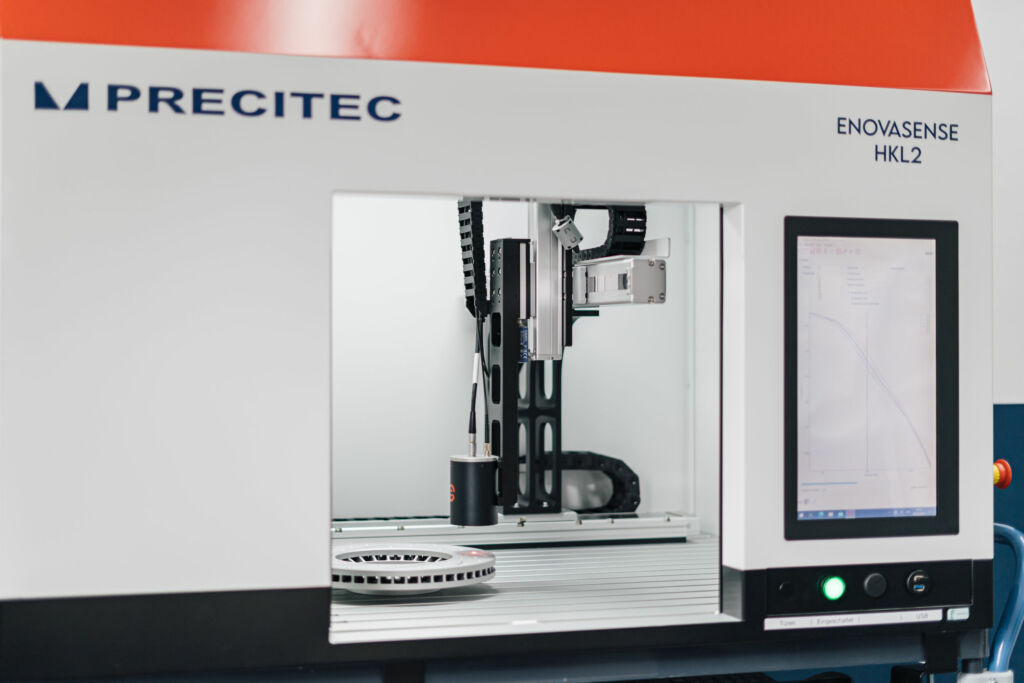
The sensor head can be integrated into an automotive production process due to its compact dimensions, lightweight design (as little as 150g), and resistance to part curvature, vibrations, or temperature. The measurement data are automatically stored, archived and streamed live to the line controller. The sensor can also be embedded in the fully automated 3-axis HKL2 control station for at-line measurement. In the control station, pre-programmed cycles allow multiple measuring points on a brake disc to be covered in just a few seconds. Once the operator has loaded the parts and configured the application, the HKL2 automatically carries out precise thickness measurements on a wide range of dry or wet/uncured coatings and all substrates.
www.precitec.com