Real-Time 3D Reconstruction Software
Multi-camera applications have always been one of Emergent Vision Technologies‘ key strengths, particularly in fields that require uncompressed, frame-drop-free recording and real-time data processing. At Vision, the company will showcase the latest version of the eCapture Pro software in a real-time 3D reconstruction demo, featuring a setup of 36x 10GigE 12MP cameras. eCapture Pro is a highly versatile, drag&drop software application designed to integrate seamlessly with all of Emergents camera systems, ranging from 5 to 100GigE. The software allows users to easily configure and integrate cameras, servers, storage devices, and GPUs into their systems using an intuitive graphical interface. In the demo, the software will be used to generate real-time volumetric video – a powerful tool for applications such as virtual reality, augmented reality, and motion capture. By capturing data from multiple cameras and processing it in real time using a GPU, the software can create fully immersive 3D environments. These environments can be explored using Meta Quest 3 VR goggles, allowing users to interact with the 3D space in real time. Whether for gaming, remote training, or entertainment, this technology enables new ways of experiencing and interacting with digital content. The most impressive aspect of the demo is that it runs on a single mid-range server with just one GPU, demonstrating the efficiency of the software and hardware integration.
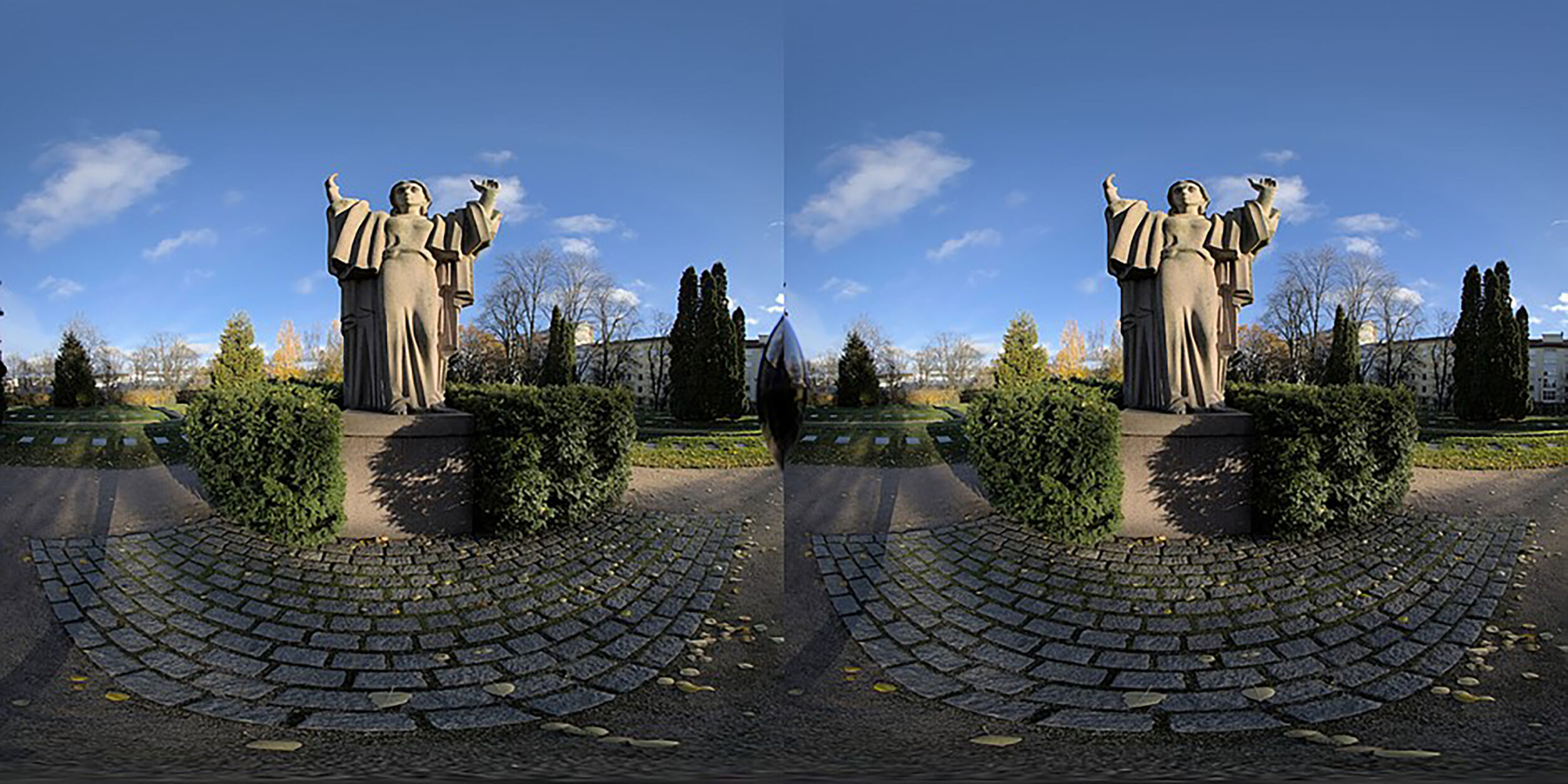
which delivers a stereoscopic 3D experience when used with a VR headset. – Image: Emergent Vision Technologies
100GigE Dual Fisheye Demo
The 100GigE HZ-65000 dual fisheye demo utilizes the powerful 100GigE 65MP HZ-65000 camera alongside the new Canon RF dual fisheye mount. This demo delivers a highly immersive, stereoscopic 3D experience when used with a VR headset, such as the Oculus Quest 2 or similar devices. The Canon RF dual fisheye lens is specifically designed for capturing outstanding stereoscopic 3D imagery, featuring two 5.2mm fisheye lenses with 60mm of spacing between the left and right lens centers. This design closely mimics human vision, providing a natural interpupillary distance and parallax for an ultra-realistic 3D experience. With an impressive 190° optical field of view, viewers can change their angle of view within the recorded scene, offering a fully interactive experience when paired with a compatible head-mounted display.
Another demo will feature a 360° panoramic view captured with an Entaniya fisheye lens mounted on another HZ-65000-G camera. This setup is particularly compelling for entertainment and VR applications, offering a fully immersive viewing experience. The fisheye lens, paired with a Canon EF mount adapter and advanced remapping algorithms, allows the capture of a full 360° panorama with a single image sensor. This capability is a huge advantage for industries that require wide-area surveillance or immersive media production. In the demo, images are transferred from the camera to an Nvidia GPU using GPU Direct technology. Once on the GPU, advanced remapping algorithms process the data in real time. This process enables high-resolution, 360° video capture and streaming, which can be used for a range of applications, including virtual reality, immersive advertising, and more.
8x 25GigE Cameras FlexProc & Flex Trans Demo
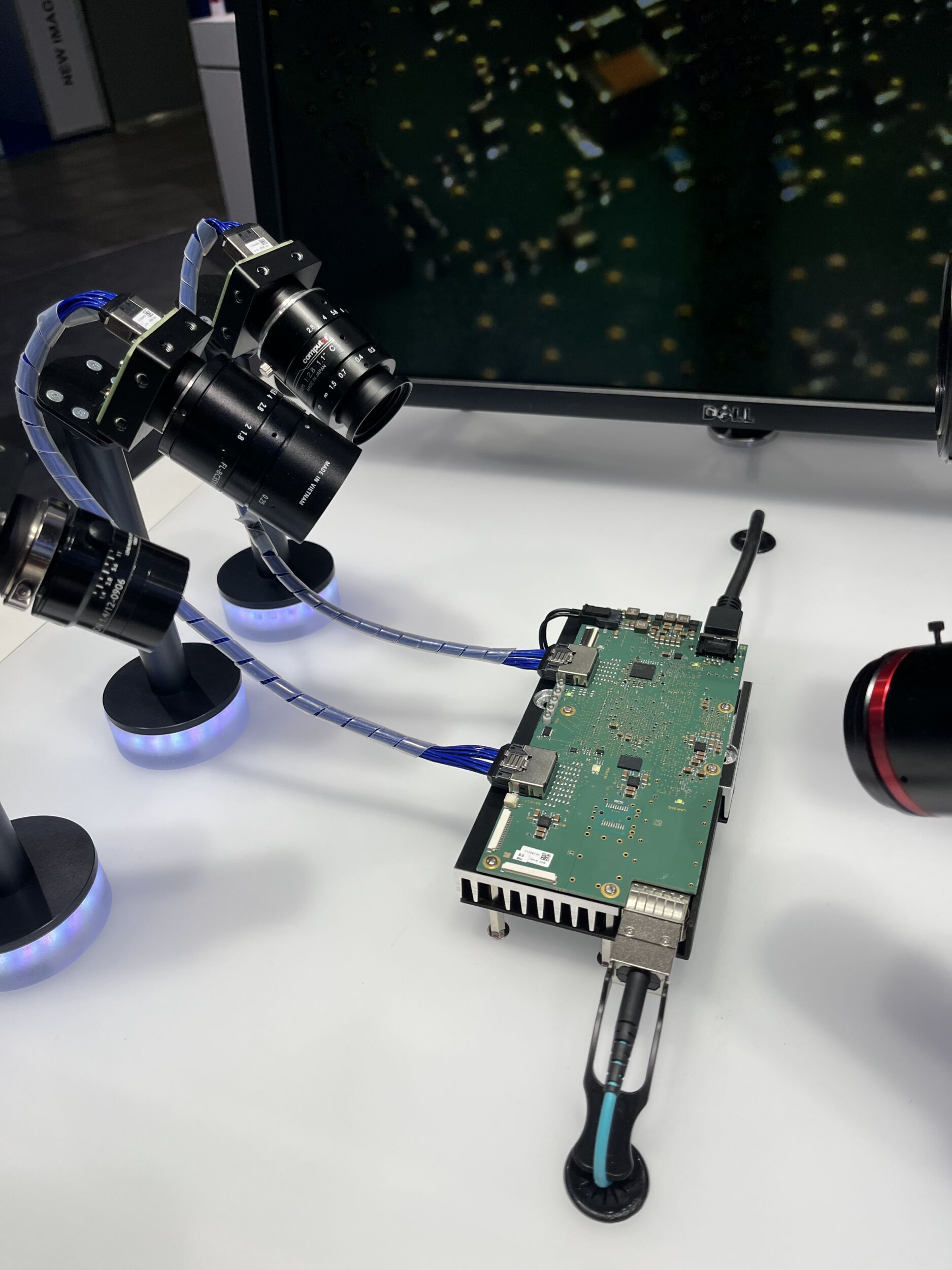
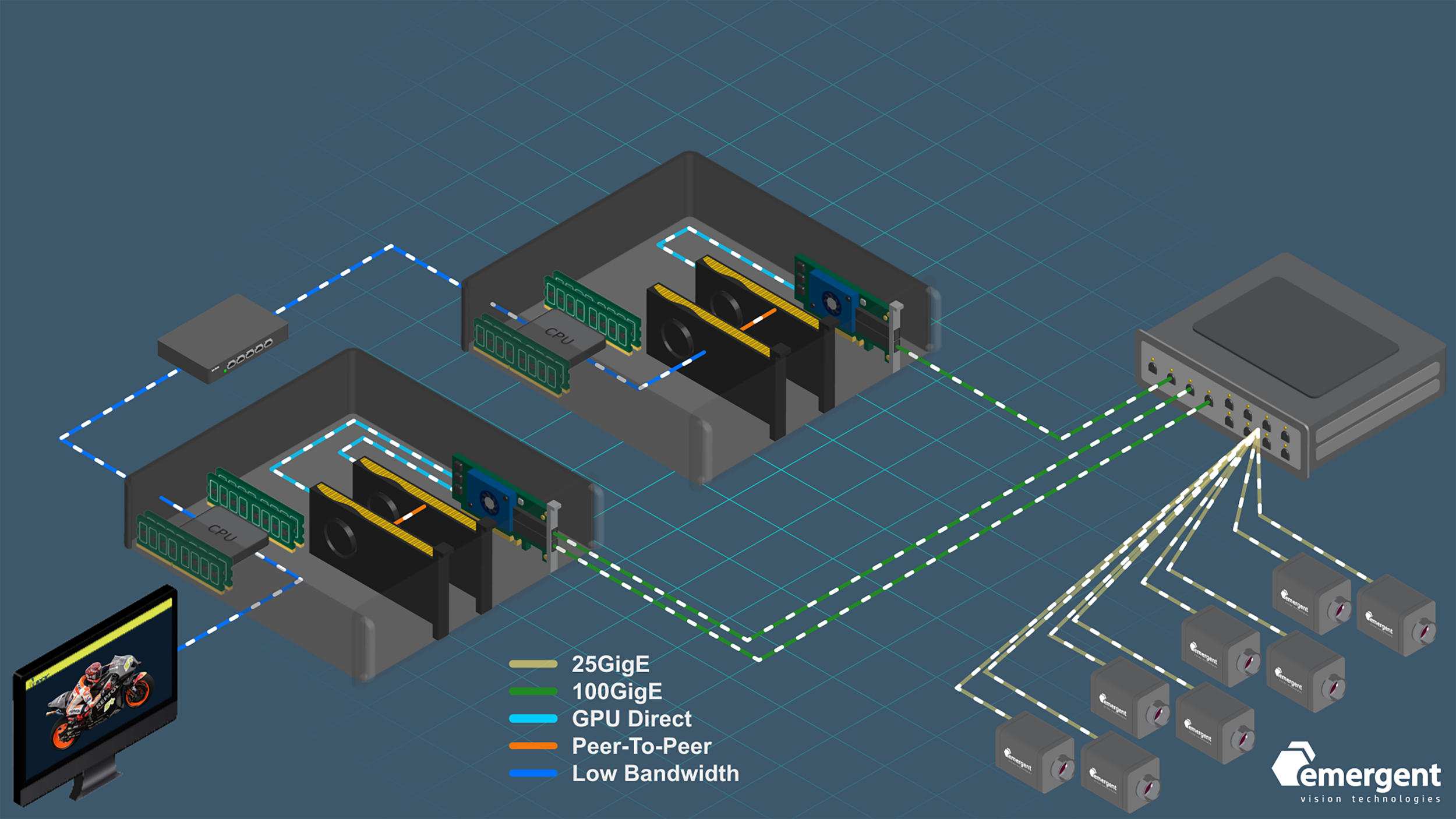
Come and witness first hand Emergent’s ability to handle any processing task with the new FlexProc and FlexTrans technology. This demo utilizes eight 25GigE HB-25000-SB-C cameras.
- FlexProc allows one to develop and easily distribute processing tasks anywhere in the system. The blocks within the graph view of eCapture Pro can be configured with built-in processing plug-ins or the user can create their own custom plug-ins. For a custom GPU plug-in, one would develop Cuda code to define the task. The code is then compiled into a .dll and this .dll defines the custom block within the graph view of eCapture Pro. With the cameras and blocks all connected within the software, the user would simply click ‚run‘ to run the application.
- FlexTrans is more than just the ability to move content from one processing node to any other node in the system. It is also about doing this with the highest performance and lowest latency possible. This means using GPU Direct and Zero Copy methods developed by Emergent. GPU Direct is a method which does direct copies and transfers between GPU memory and the network. A seamless transfer of high performance data between a GPU in one server to a GPU in another server can be done. Peer-to-peer is a method to do direct copies and transfers between GPUs within the same server.