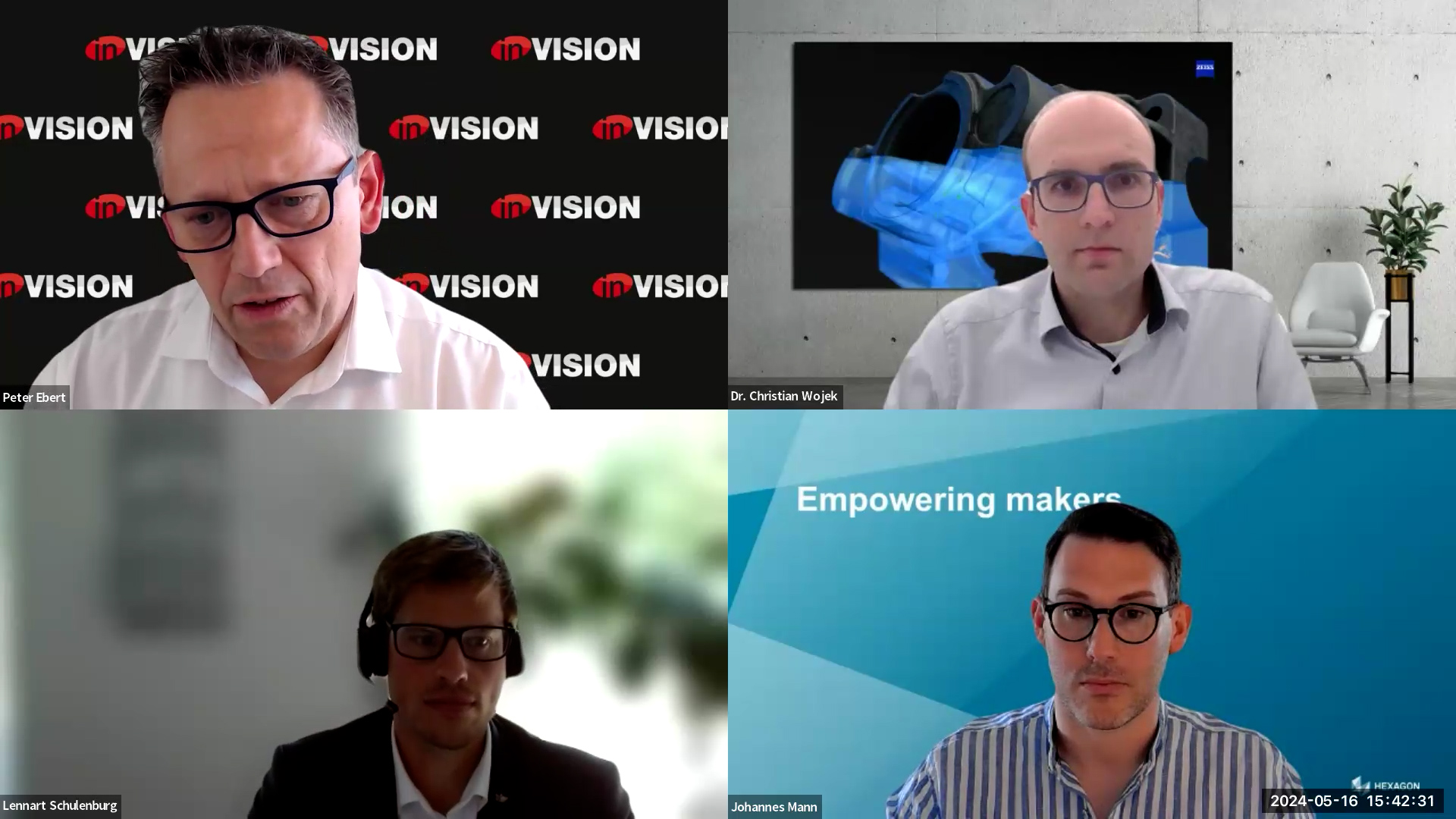
Is AI already being used in metrology applications and if so, where?
Dr. Christian Wojek (Zeiss IQS): We at Zeiss are already developing a wide range of applications with AI and have been dealing with the topic for several years. Microscopy was one of the starting points. We have applications such as layer thickness measurement, particle detection in technical cleanliness or grain analysis. Recently we have been working on noise reduction for X-rays. We also carry out CT and X-ray inspections of weldings for various applications. Porosity is one of the most obvious phenomena in castings. And last but not least, we find in NDT inspection particles or defects in all applications thanks to AI.
Lennart Schulenburg (VisiConsult): AI already is a very powerful tool, especially for defect detection. It will become more and more adopted to support operators in creating trajectories, measurements plans, but also in accessing information. We tend to mostly think about the analytical side of AI, but also the generative side will have huge potential in the near future.
Johannes Mann (Hexagon): AI makes knowledge more accessible to everyone, as it is particularly about metrology which is a very demanding area. AI is also used in data acquisition, which will allow us to collect and process data better, but also speed up or simplify subsequent data analysis.
What are the challenges, especially for the user, when AI is used?
Mann (Hexagon): AI is as good as the training material. Depending on the quality and ground truth of the material, different results arise. If we look at the metrology aspect, we know that when I measure something, the accuracy I get is the part as I measure it and the measurement inaccuracy. It is very difficult for AI to define a specific inaccuracy for the metrology system itself.
Schulenburg (VisiConsult): In metrology and NDT we must measure precisely. When using generative AI there is always a risk of inserting something into the measurement data that was not in the particular scan but rather the training data. Especially if it was used for reconstruction or denoising purposes. That doesn’t mean that AI doesn’t work for these use cases. It has its merits, and it can improve results, but we have to be careful. At VisiConsult we design experiments around each application of such tools to verify that there are no so-called hallucinations in the results. A huge challenge for analytical AI for defect detection is the need for massive volumes of labelled data. This creates a sizable hurdle for the implementation of AI for companies. Our company has moved away from a use-case-specific training and has developed big foundation models. These are pre-trained models that are trained on several hundred thousand labelled scans. This significantly reduces the effort in creating a specific model by just finetuning it on a small dataset.
Wojek (Zeiss): Especially when we focus on demanding applications, like high noise levels, fast cycle times, very dense materials…, we see great benefits with AI. This is very tricky for traditional algorithms, but it absolutely depends on the quality of the data. What is important is to have tools for efficient annotation to obtain high quality data. If there are bad data in the models, the results can’t be great.
Is AI for the users or is it more for companies to get better systems and the users don’t see that they are using AI?
Schulenburg (VisiConsult): AI is not a simple technology, and developing AI tools requires data science background knowledge, lots of data, and a significant investment of time. That is nothing we want to place as a burden on our users. It should be a simple plug-and-play solution that is very easy to finetune in the field. Simplicity is key, because our customers are metrologists, quality inspectors and so on. They are not data scientists or programmers. That’s the main reason for our company to invest a lot into our foundation models that can be applied for the most common inspection tasks out of the box.
Mann (Hexagon): AI needs to be set up properly so that the user can end up using it and actually benefiting from easier handling or faster cycle time. If there’s too much to do with AI training and making sure that the right and enough data is there than in most cases the full benefit isn´t achieved for the customer.
Wojek (Zeiss): You need to look at who is working with the system. The user, at an inline application, will not be training the AI. But we definitely want to make it possible for the people who are dealing with quality in the process or training these systems. Therefore, the tools must be very easy to use. You don’t want to deal with the statistics and the fine-tuning of the parameters, this is more for data scientists, but I’m optimistic we can get to this level.
Is AI only used for slow applications such as in the measuring room or is it already used for shop floor or inline applications?
Wojek (Zeiss): It’s both, but the focus is definitely a little bit different. When it comes to the measuring room, the most important thing is ease-of-use and interaction. You have someone in front of the system double-checking what the outcome is. When it comes to inline or shop floor automation, speed and high performance are more important.
Mann (Hexagon): When we look at the lab, where someone is really striving for absolute precision and very fine detail, it’s the right tool to get more out of the data that you have. On the other hand, if you take enough time to train the AI well for use in inline applications, you can use some of the precision gained to cope with potentially lower quality data due to long cycle times and still achieve good results. So one thing is to focus on gathering the data quickly and still getting precise enough results and on the other hand, it’s about achieving the greatest possible precision.
Schulenburg (VisiConsult): To be clear, the main value proposition of AI tools is to increase efficiency. That means increasing throughput and reducing the inspection time and effort. Of course, the importance for such efficiency increases are bigger on the shopfloor and in the laboratory, but today nearly everywhere NDT resources are a bottleneck and efficiency highly sought after. Our AI tools are already used in the production lines on so called in-line systems, but also off-line in the measurement room. With the right hardware, there is no limitations in applying AI to any of these settings.
Schulenburg (VisiConsult): The holy grail of our industry is to automatically create the perfect measurement plan within seconds without any human input. Particularly in CT, if you have high density areas or very thick sections, your CT system could take that into account and generate a trajectory and maybe even use some exotic inspection trajectories to find the best possible projections through the part. It is very difficult for a human to choose the perfect trajectory for a CT system. If you have an AI that actually optimizes the trajectory and chooses the right projections automatically, there’s a huge potential for better and faster scans. We’ve proven in our lab that AI-powered trajectory generation reduces the number of projections by a factor of ten without sacrificing quality.
Are AI-based metrology tools meanwhile good enough or do humans still have to make the final decision about whether or not a part is good?
Schulenburg (VisiConsult): Many factors play a role, starting with standards and regulations. The first question is: Does the standard allow an AI or computer-based system to make the decision? In many industries, like oil and gas, defense or aerospace it is a no-go. And then there is the customer specification and the technical feasibility. If the measurement results are repeatable, precise and reliable, there is absolutely no reason why the machine cannot make a final judgment. This has already been the case prior AI by using classic image processing. In other cases, the regulatory framework may make this quite impermissible. What is possible in any case, is deploying AI as an assistant tool to augment the inspector. Leading to higher efficiency and quality.
Wojek (Zeiss): We’ve done something like this before with traditional algorithms. Sometimes it didn’t work well, and in many cases AI is now a plug-in replacement. You create segmentations using AI and then do everything as before. For example, you set your standards, evaluate against the standards you have, and then you have to adhere to those rules whether you use AI or not.
Mann (Hexagon): It mainly depends on the regulations whether it is allowed or not, because there can be certain inaccuracies with AI. But if you look at human operators, the skills aren’t perfect either.
Schulenburg (VisiConsult): When AI has been brought to the table, people say, well, it’s a black box, which I can’t trust because I don’t know how the decision was derived. What I like to ask in that case: Can you look into your operator’s head and can you see what they’re thinking? Why do they make their decisions? Because a natural intelligence system, i.e. humans, also makes decisions in a black box based on experience. An AI makes decisions in a black box based on experience as well. Both are qualified based on statistical parameters such as probability of detection (POD) or an MSA study. This is a major transformation in how we thin about decision systems and we will see it reflected in the newest inspections standards that are created right now.








![Die [me] – mechatronik & engineering wird digital](https://cdn.tedo.be/tedo-mu/wp_uploads/sites/10/2026/03/Unbenannt.jpeg)