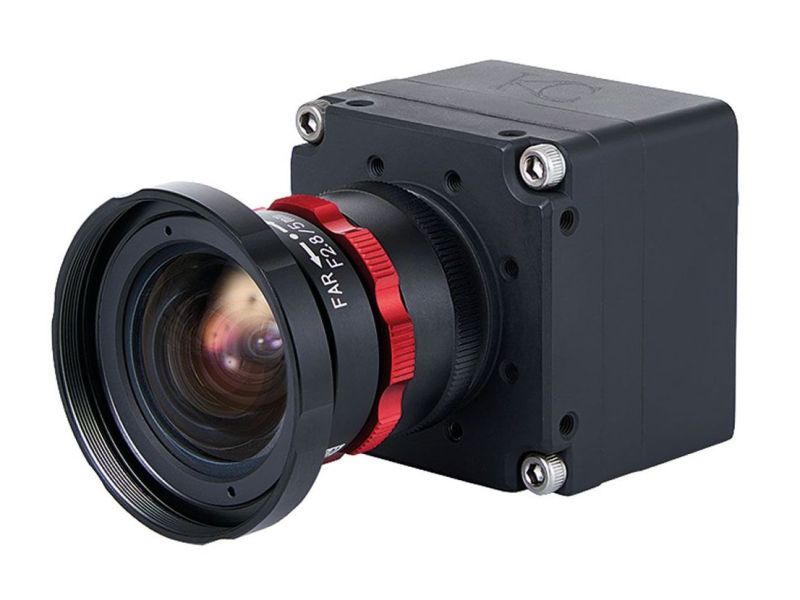
- In moving systems such as robot arms or slip rings, UTP cables not only have the benefit of their affordable price. They are much thinner and more flexible than USB or GigE cables and highly resistant to bending and torsion. This is also the case of micro-coax cables which are extremely thin and flexible. One use case example for MIPI A-PHY-based chips can be replacing a large and costly machine vision camera with a lightweight embedded camera installed at the end of a robot arm.
- Like humanoid robots, automated mobile robots (AMR) in logistics have specific constraints in size, weight and power (SWaP). A-PHY not only saves space, it also saves precious battery power, minimizes heating. With about 200mW power consumption for data transmission, A-PHY has a major competitive advantage versus established interfaces. On the camera side, it is lower than CoaXPress by a factor twelve (2.5W) and lower than 5GigE by a factor 30 (5-7W).
- Smart cameras are already a mini-embedded vision system. However, their connectivity includes up to three cables (power, data and trigger). These industrial cables are not only costly, but they are also less flexible for drag chains or other moving applications. Replacing these three connections with one A-PHY link simplifies the system architecture while reducing the bill of material.
High performance at a low cost
The automotive industry is one of the industries with the highest safety and quality standards while at the same time maintaining a high cost pressure on every single component. MIPI A-PHY is an outcome of this challenge: it delivers high performance, high signal integrity and high durability at a low cost. This makes it an ideal candidate to overcome embedded camera interface limitations for machine vision applications. It may even be an attractive alternative to established interfaces in PC-based systems where the form factor and/or the cost of cables becomes an issue.
www.valens.com







![Die [me] – mechatronik & engineering wird digital](https://cdn.tedo.be/tedo-mu/wp_uploads/sites/10/2026/03/Unbenannt.jpeg)