Integrating multiple sensors into a cohesive system remains difficult because each sensor produces different types of data and often operates at different sampling rates and communication interfaces. Cameras generate high-bandwidth image streams, Lidar systems produce 3D point clouds, while other monitoring devices generate lower-bandwidth scalar data. As a result, developers must solve challenges associated with synchronisation, sensor fusion, bandwidth management, AI integration, and system interoperability. Many projects require extensive middleware and custom host-side software, significantly increasing engineering effort.
Moving Intelligence to the Edge
Advances in embedded processors and AI accelerators have enabled more processing to occur at the edge rather than on centralised host computers. Edge AI makes it possible to perform object detection, segmentation, anomaly detection, and depth estimation directly beside the sensor, reducing latency and bandwidth requirements. However, edge processing creates a new challenge: transporting raw sensor outputs, metadata, and AI inference results in a consistent and efficient manner. In many implementations, these elements are transmitted separately, increasing integration complexity. A more effective approach integrates AI results directly into the sensor acquisition pipeline so that processed data and metadata remain synchronised throughout the system.
Standards-Based Data Representation
Machine vision standards such as GenDC (Generic Data Container) and GigE Vision provide a foundation for solving these challenges. GenDC enables different types of data, including 1D, 2D, and 3D information, metadata, and AI results, to be represented within a common structure. GigE Vision 2.2 extends this capability by enabling standardised transport of these data streams over Ethernet. Using standards-based containers reduces dependence on proprietary formats, simplifies integration of sensors from multiple vendors, improves interoperability, and lowers software development costs.
A Unified Edge-to-Host Architecture
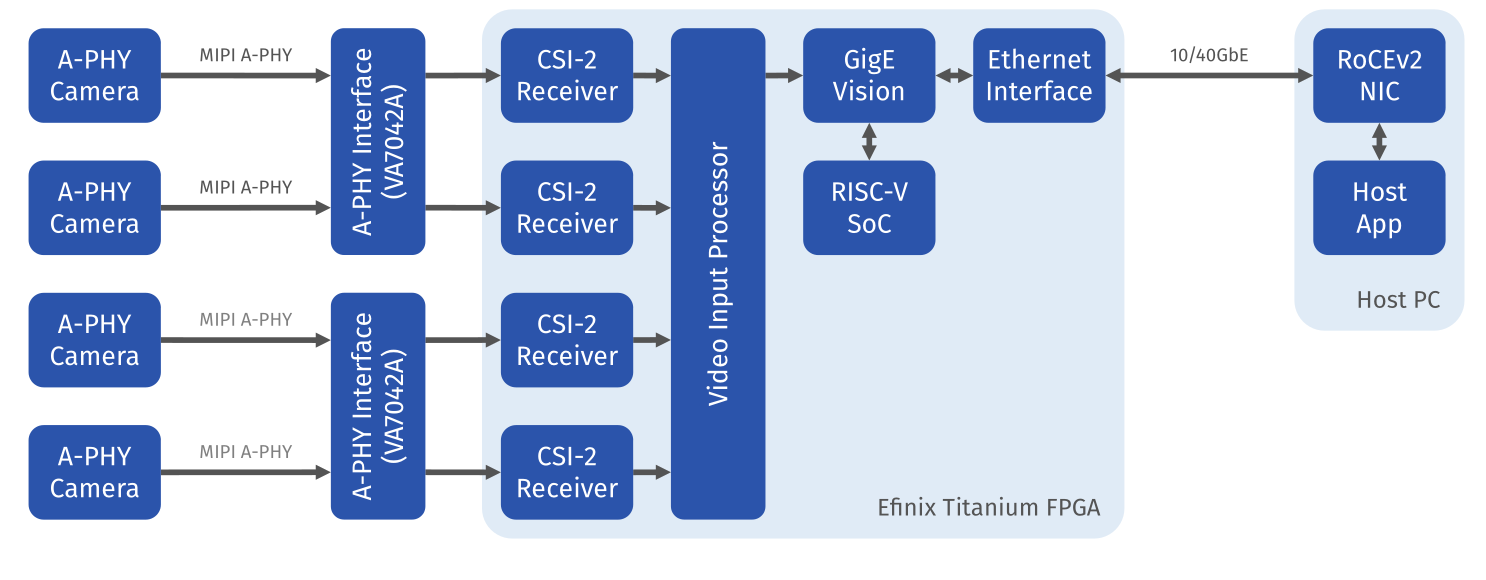
Multisensor edge integration platforms extend these concepts into a complete workflow. Vision and non-vision sensors connect to an embedded processing platform that performs synchronisation, sensor fusion, and AI inference. The resulting data stream, including AI-generated metadata such as object classifications, confidence values, and bounding boxes, is packaged within a standardised container and transmitted over Ethernet. On the receiving side, software tools unpack the data, provide synchronised visualisation of multiple sensor types, and maintain device control and configuration. Rather than managing separate sensor feeds, developers work with a unified perception stream that combines image data, depth information, environmental sensor readings, AI results, and control information.