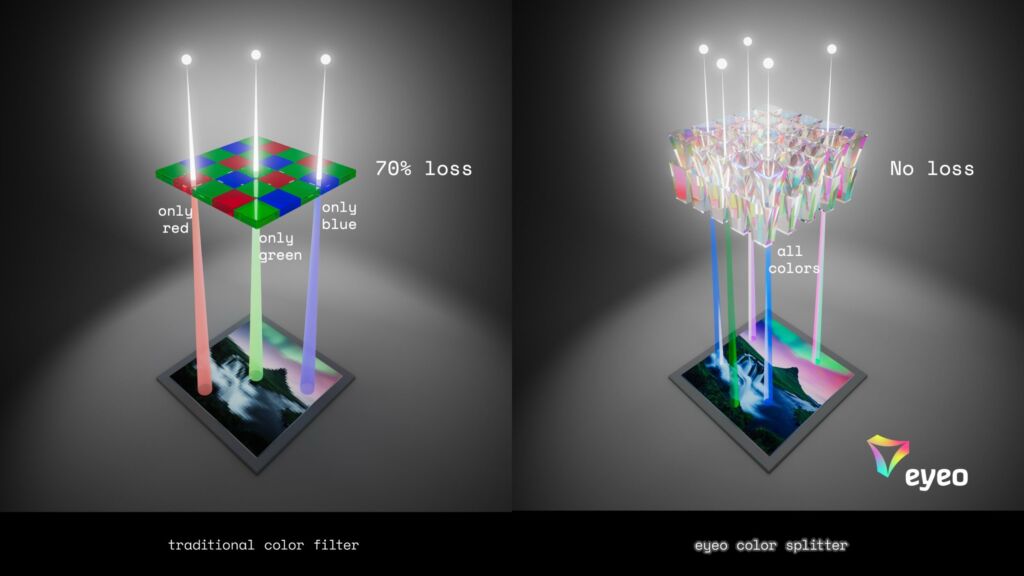
The Bayer pattern, introduced in the 1970s, remains the standard approach for capturing color images, but it is inherently inefficient. Each color filter absorbs much of the incoming light, blocking up to seventy percent of the photons before they ever reach the sensor. To compensate for this loss, manufacturers have had to increase pixel and sensor sizes, which raises production costs and results in bulkier camera modules. At the same time, because each pixel only records one color component, the missing information must be reconstructed through interpolation, reducing both image sharpness and color fidelity.
These compromises become even more problematic as the industry continues to push for smaller pixel sizes. When pixels approach the scale of a photon’s wavelength, about one micron, the situation worsens: photons are increasingly ab- sorbed or blocked by neighboring filter elements. This interaction adds further light loss on top of the about seventy percent already caused by the filters them-selves, revealing a fundamental limitation of the Bayer architecture as sensors scale down. These problems are most evident in smartphones, where the camera has become the primary driver of consumer choice. To improve image quality, manufacturers have consistently adopted larger pixels. That solution makes devices more expensive and increases the space re- quired for the camera, which runs against the push toward thinner, lighter phones.
Photonics-based color splitting
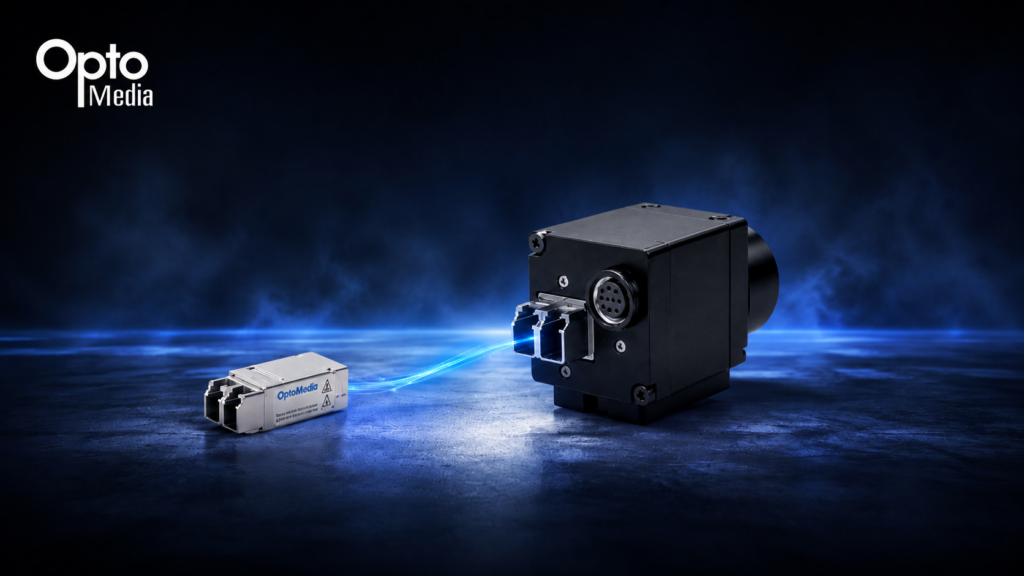
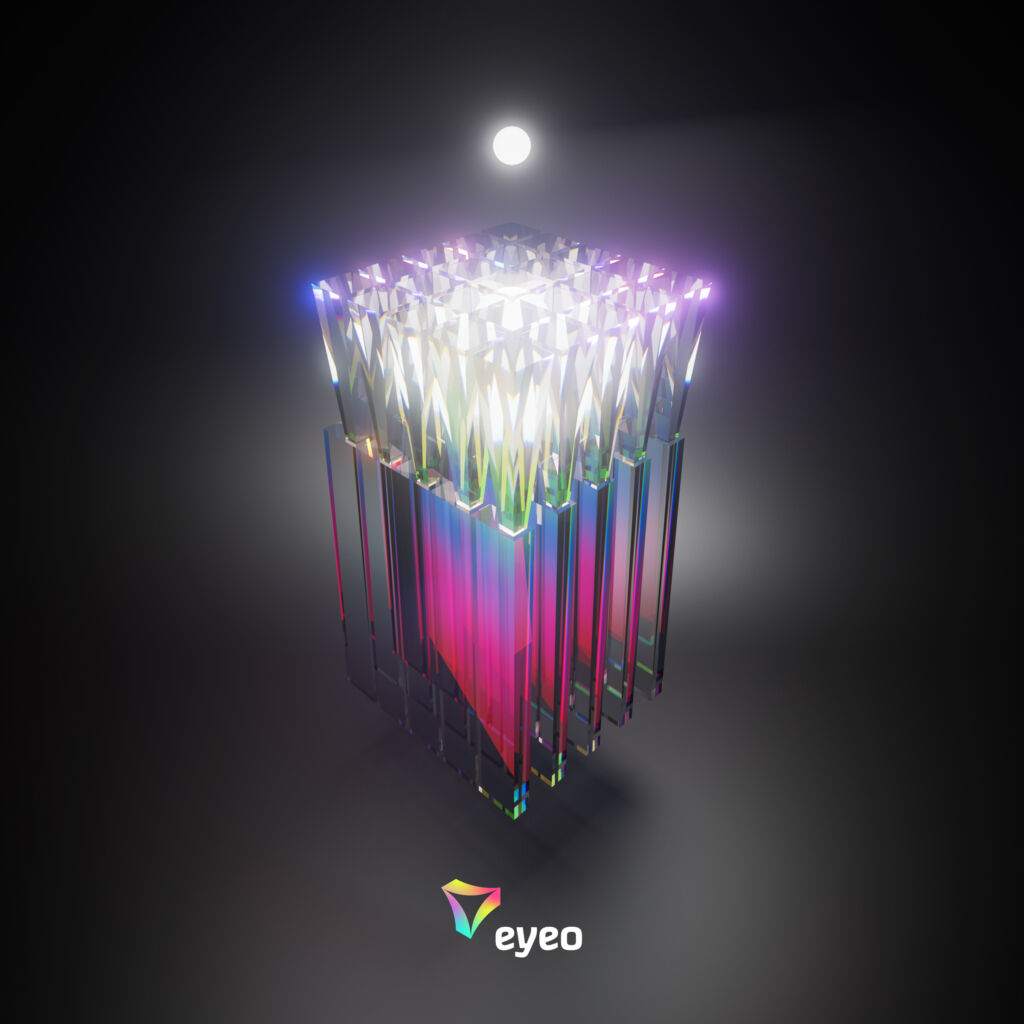
A new approach, developed for more than seven years at imec and now ready for commercialization with Eyeo, uses nanophotonic structures rather than filters to separate colors. Vertical wave- guides with tapered openings channel incoming light, splitting it into its constituent wavelengths with sub-diffraction precision. Because the system directs photons instead of absorbing them, it achieves <0.5µm pixels while maintaining full and true resolution. The method is fully compatible with standard CMOS production, since it applies silicon photonics techniques that can be integrated into existing semiconductor lines. OptoMedias ultrakompaktes Mini SFF bringt zuverlässige, schnelle Glasfaserverbindungen in Industriekameras der nächsten Generation. ‣ weiterlesen
Fiber Mini SFF für GigE Vision
This photonics-based strategy changes the performance profile of image sensors. Eliminating absorption increases sensitivity by a factor of three compared to Bayer filters, which greatly improves performance in low-light settings. Each splitter captures full color data, effectively dou-bling resolution and removing the artifacts common to filter-based systems. Because the sensors can achieve strong results with less surface area, they support more compact and lightweight designs. This allows smaller cameras in smartphones, AR or VR devices, and medical instruments without compromising quality. On the production side, the absence of color filter deposition and microlens alignment offsets the complexity of adding waveguides, keeping manufacturing costs competitive. Lastly, extreme color resolution is a- chieved over the full visible spectrum thanks to eyeo’s proprietary color splitter design.
Target applications
The potential applications are wide-ranging. In smartphones, the technology supports slimmer designs while delivering higher image quality. In AR and VR, it makes compact sensors with high resolution and sensitivity possible, which are essential for immersive experiences. In security and surveillance, stronger low-light performance im-proves monitoring and detection. Industrial imaging gains from sharper images and higher frame rates that benefit machine vision and robotics. Automotive systems, including advanced driver assistance and in-cabin monitoring, benefit from the combination of high sensitivity and accurate color. Medical imaging devices become more portable and efficient while delivering more precise diagnostic information at a lower power budget.
The concept has been validated in scientific studies, including a presentation at the 2023 IEEE International Electron Devices Meeting. The work, titled Wafer-level-integrated vertical-waveguide sub-diffraction-limited color splitters, demonstrated sub-micron resolution on 300mm wafers using standard back-end processing. Researchers showed that the waveguide geometry can be tuned to align with human visual sensitivity, and the results indicated higher signal-to-noise ratio, improved color quality, and enhanced resolution for advanced camera systems.