Operations optimization is one of the main market demands in retail. Missed buying opportunities due to slow restocking and the time consuming price tag changing process are two main areas of improvement. Nowadays, the markets‘ staff still needs to ensure that always the right quantities of goods are available for the consumer and that they are sold before the end of their useful life. This requires periodic manual checks on the stores‘ stocks, evaluation and reassessing the condition of perishable products on the shelves and their correct pricing.
Recognizing products
on the shelf
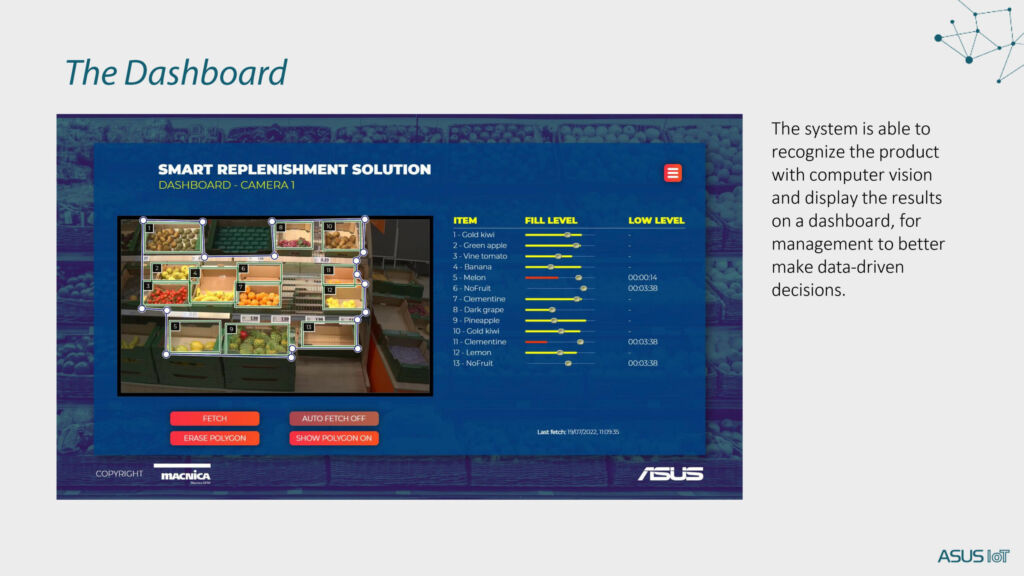
In a real life supermarket of a major retailer in Europe, however, things are now handled different. Here, the fresh food shelves never get empty for no reason as they are being observed by cameras. Aiming to disburden personnel and further improving restocking as well as price tagging, the leading European supermarket chain implemented an AI-driven solution which was jointly developed by Macnica and Asus IoT for the specific needs of supermarkets. The system recognizes the products on the shelf, its level of stock and automatically updates the price tags under the products. Shelf Compliance – Smart Replenishment & ESL Solutions is the working title of the project which was tested several months under real conditions and has now been carried out successfully. „Relying on an intelligent solution for stock in markets and supermarkets is one of the main points to achieve success in this sector. Our solution is able to recognize the products with computer vision and display the stock results on a dashboard, for management to better make data-driven decisions“, explains Silvia Kuo, Business Development Director at Asus IoT.
Fill level monitoring
The entire solution is a cooperation between Macnica and Asus. The hardware which in the current version is an EBE-4U Edge Computer; the API software and the AI engine are coming from Asus. Macnica contributes the front end interface with the user as well as important back end functions for labeling and capturing photos and to provide anonymization on data. All the images taken by the cameras are anonymized and treated to provide the detection of the QR codes for each product of the Electronic Shelf Label, and then the collected images are being sent to the Asus API for continuous recognition of the items and the actual fill level.
Store management on the dashboard can determine regions of interest for each of the stock monitoring camera units. It is possible to define a fill level limit for each perishable product shelf without barcode. „For this, certain parameters are considered, such as: size and average daily sales quantity. In addition, it is also possible to define which specific levels should generate replenishment alerts for certain products. For example: the threshold level for watermelons can be quite different from the one for bananas“, describes Silvia Kuo from Asus IoT. For the fresh food area in the supermarket, data collection to train the AI engine started with picture acquisition for display box detection training taken out by Asus. Macnica then integrated the box detection model into the system. This was followed by the on-site master data collection of the target products in different lighting conditions and using the retail customers´ labeling. With that data Asus developed the pre-trained model and enrollment API which was integrated into the Macnica module and further improved in accuracy.
Tracking the turnover
ratio of fruits