Cubert has been working with HSI for a very long time. Why are you now making a concerted push into the machine vision market?
Rene Heine: 2013 our cameras had 50×50 pixels resolution. OK, it’s hyperspectral, so in each pixel you have a full spectral response curve, but very few industrial imaging application need this low resolution. 2019 we could introduce our first megapixel hyperspectral video camera which was a big step towards industrial imaging. Since then we push toward that market. But that is just the camera with very complicated data in the end. Until now we provide very good cameras but not the complete application. So far a spectral imaging expert was needed to get the application to the customer which is a big hurdle to get a broad acceptance in the market. Our next step is now that we have an AI underlying which helps users to build applications, in the best case with no expertise at all.
Another drawback of hyperspectral imaging cameras has been the high price. Will that change?
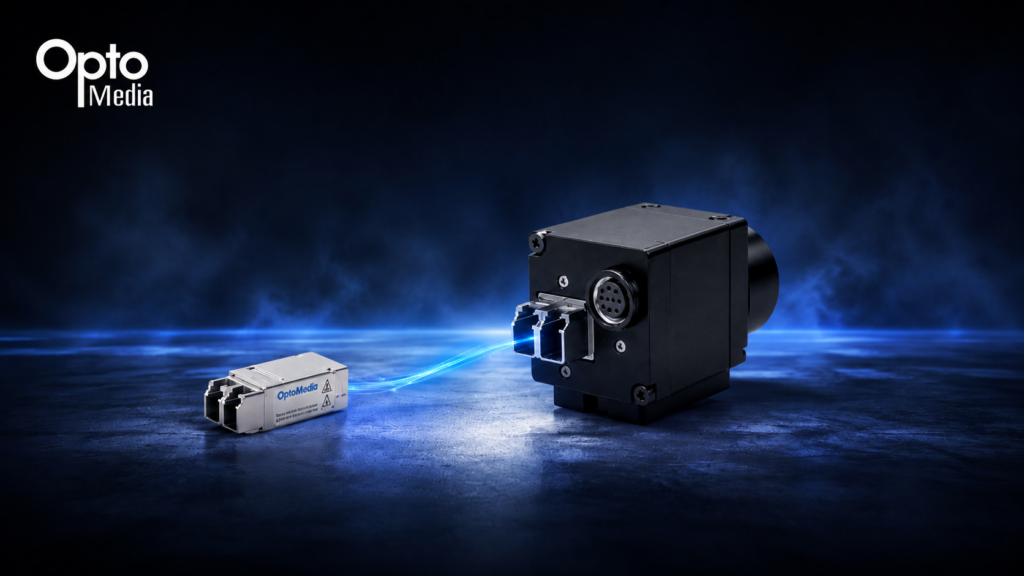
That’s the biggest issue we see as well: the price of the cameras are way too high. But HSI is still a niche market, meaning the amount of cameras is smaller than in industrial imaging. Therefore, the prices are higher. But as soon we get into more applications, the prices will drop significantly and we are already on the way to do that. In the end, the price depends on the complexity of your issue. What we build now is not a camera, it’s a tool box of different solutions for different applications, starting with very easy cameras for small problems, which get very close in price to RGB cameras. OptoMedias ultrakompaktes Mini SFF bringt zuverlässige, schnelle Glasfaserverbindungen in Industriekameras der nächsten Generation. ‣ weiterlesen
Fiber Mini SFF für GigE Vision
What is a very close price?
If we have an application and we need only three channels, but just different wavelengths, we are getting very close to RGB camera prices. If you’re going to need six channels, it´s getting a bit more expensive, and if you finally want to move to sphere or even wavelength ranges, then the price rises. We don’t want to sell expensive hardware, our goal is to provide better solutions. What we aim for is if you have an RGB camera, with 95% specificity for any application. We want to go to 98% and increase the quality of your sorting. That should pay for the additional price the hardware might cost. But it’s not just the cost of the camera, which is making the breakthrough complicated, it’s rather the price of finding the solution. In spectral imaging finding the right solution is complicated. It tends to be more like a quarter or half a year to develop a new HSI solution. We put in a lot of effort to get down from quarters to weeks and now to days to present the right solution.