What is the most promising technology approach to cost down SWIR camera technology?
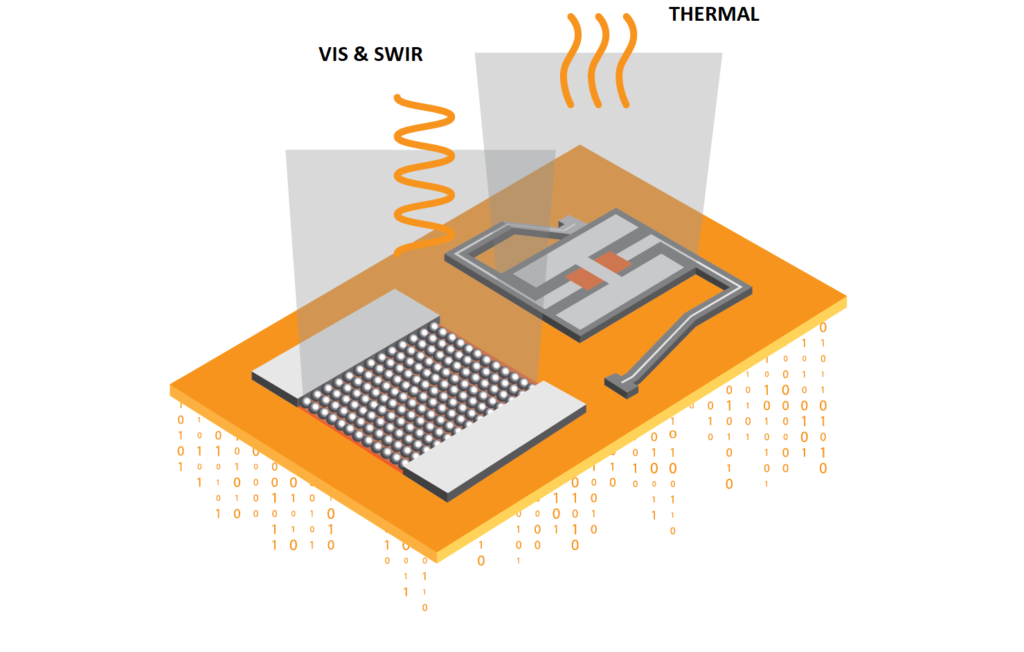
Cheskis: Typically CMOS based sensors like ours are orders of magnitude cheaper than an InGaAs based sensor. We think that we can put these sensors into mobile devices and then we can really reduce the cost of SWIR cameras.
Klemm: In theory, we offer extremely low cost technology. In practice, we’re limited on buying wafers in small quantities from a foundry. So most of our cost is driven by silicon wafers and the fact that we have some pretty large sensors we’re producing today. Our cheapest camera is a VGA which is just sub $7,000 for single units and our most expensive is a 2MP camera just under $20,000 for single units. We’re now going to offer a 6MP camera. However, please don’t be concerned about those prices. These are prices for applications where people are buying 1, 2 or 10 cameras. It becomes a different conversation when you’re talking about 1,000 units or 10,000 units.
Zimmermann: As for the sensor price, at Sony it depends on the volume and the application. We see more and more applications we haven’t seen maybe one or two years ago. In addition, what we see now are inquiries for volumes that we have seen before just for global shutter technologies. Bringing up the volume will automatically decrease the price. I’m not saying a SWIR sensor from Sony would be at the cost level of a global shutter sensor in future, but the gap becomes smaller and smaller as the quantity increases.
Larive: People say shortwave is expensive. In fact shortwave is not that expensive already now. It will come with quantities and the price will decrease definitely. What will be the breakthrough? The general trend of the electronic for sure, but the quantities will be the key. If you can optimize the camera configuration and of course the quantities then we can optimize the price.
VIS-SWIR cameras already exist, but what about visible LWIR cameras?
Klemm: We would love to build a LWIR with balometers, but balometers are a MEMS structure. There are people that have tried to integrate SWIR with long wave in the US over the last 15 years. It’s not trivial to integrate a balometer with a SWIR pixel but it certainly seems feasible and we would welcome the opportunity to collaborate on that if somebody reach out.
Larive: The visible long wave is not only a question of sensor, it’s also a question of the general architecture, including the optics. On the other side if you look at one trend using LEDs or laser, you are not going broadband, you are going much narrow band.
Cheskis: If you asked any of the machine vision or imaging people if they wanted more spectral content, they would say yes. But the question is how do you get it and at what cost in terms of devices, system, size, power consumption… The question is what do you get for doing all of that?
Hashagen: Every spectral range has its applications and most suitable sensor types, but why should we consider visible LWIR? It is a too broad spectral range and all the technical challenges have been named starting with optics. So it doesn’t really make sense for me and I would be really interested to know what it would cost to realize such a system or sensor.
What about optics for SWIR cameras?
Hashagen: There are a lot of optics available. You can use standard optics, especially if you’re doing narrow band imaging. For imaging in the full spectral range from visible to SWIR, there are well known optic manufacturers available who do optimize lenses. These lenses have no dispersion in the image so you’re not losing the focus, but are a little bit more expensive than standard optics.
Larive: A lot of people put a specific filter on the SWIR camera to remove the visible from the shortwave. With VIS-SWIR you can take nice pictures, because you have visible light but you dilute the shortwave information. On the other hand I see more things in the extended sphere above the standard InGaAs wavelength.
Hashagen: That’s true for extended range imaging. The optics are a little bit more difficult to get because they are mainly optimized to 1.7µm. Some of them offer a reasonable transmission beyond this range, useable with, for example, MCT or extended range InGaAs sensors. So it is possible to image also in this range beyond 1.7µm, with some disadvantages regarding the transmission and the image signal that you get.
How can QD sensor price reduction be achieved if it is known that the production of QDs is high?
Klemm: There are high volume production of quantum dots in the world, particularly in the display world where they’re used in QLED displays. A price reduction frankly comes from us being able to buy cheaper silicon because we start with the silicon readout chip that’s got amplifiers and etc. and then we build our photo diode on top. The wafer comes from a foundry and when we buy 25 wafers at a time, it’s pretty expensive and when we have large dye it’s also pretty expensive. The best path towards much lower cost is if we can produce SWIR sensors for thousands of units a year instead of hundreds.
What about UV: is this a technology for the future?
Zimmermann: Sony has recently launched a new UV sensor. They already had a UV CCD-based sensor technology for more than 20 years. We did see some applications, but it’s very specific in particular, like in the semiconductor area and also for power line inspection. Today UV is pretty niche and we see volumes mainly below 100 pieces by customer project. Therefore pricing is comparatively high. But there is definitely a reason why Sony launched a new UV sensor.
Hashagen: UV is definitely a bit difficult because you have to protect the human eye from UV light. Doing long range imaging with UV doesn’t make sense because it’s absorbed strongly by the atmosphere. So UV imaging is a kind of niche market.
Larive: I have a different view, probably because we do UV and sell UV cameras in quantities. We have solution for solar blind UV so you are not polluted by the light coming from the sun. It is definitely a market in machine vision for years, e.g. for powerlines inspection, metrology or defense.
Participants
Jens Hashagen, Busines Development Manager, Allied Vision
Sascha Zimmermann, General Director Sales, Macnica ATD Europe
Dr. Ethan Klem, CTO, SWIR Vision Systems
David Cheskis, Senior Produnct Director, Trieye
Marc Larive, Strategic Marketing Manager, Xenics
Host: Dr.-Ing. Peter Ebert, inVISION