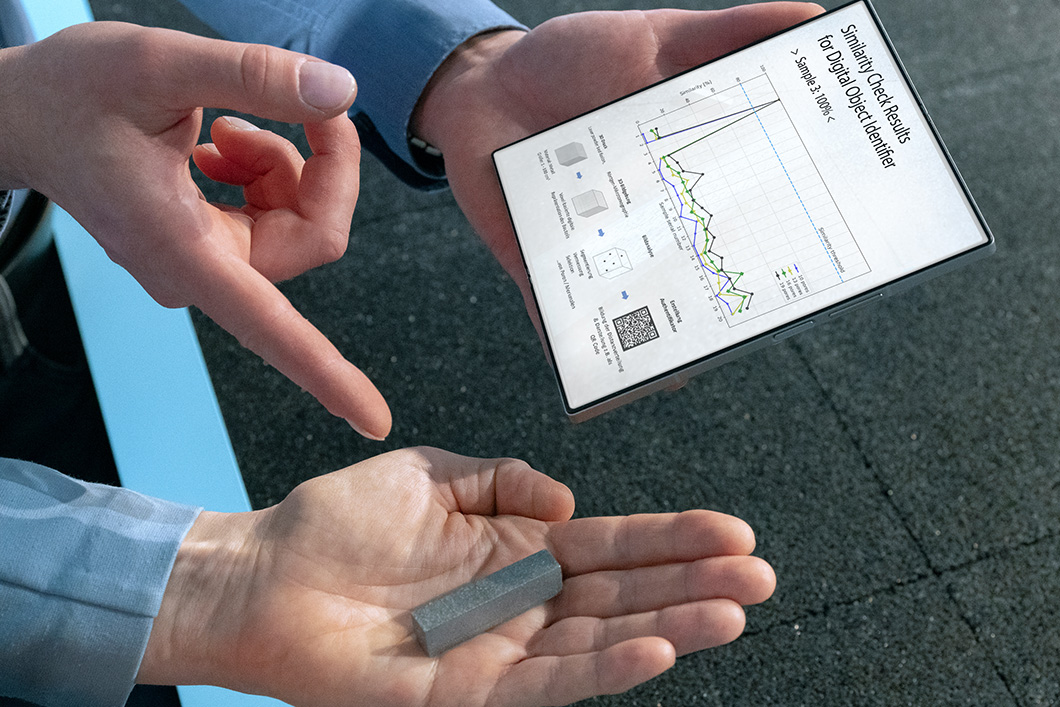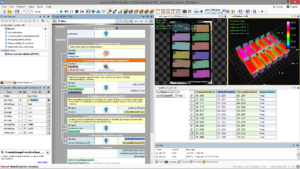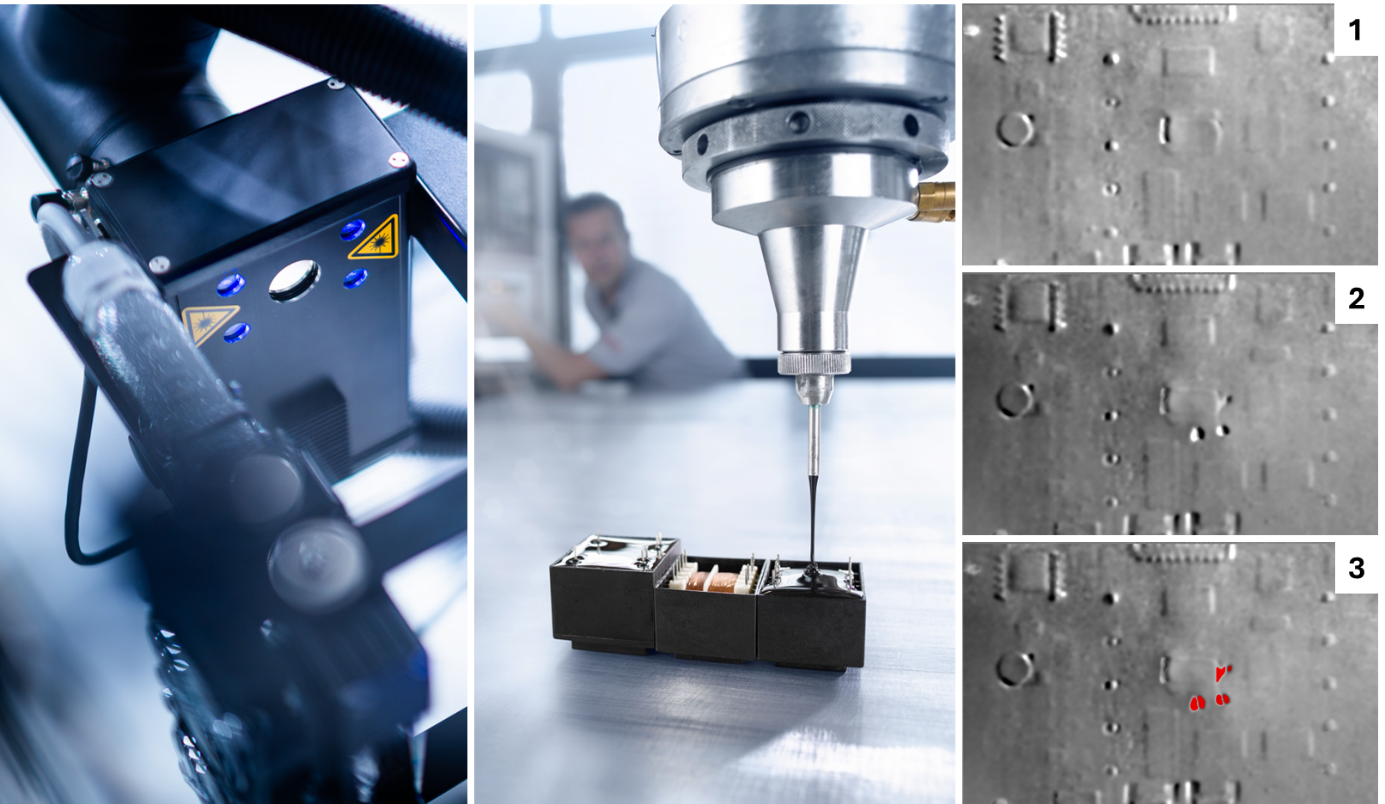
The inspection technology uses laser speckle interferometry to detect internal defects in materials. Test parts are stressed with a minimal energy input, causing nanometric-scale deformations. These deformations contain information about the internal mechanical structure of the part. In a deformation analysis, this data is captured, processed, and visualized in a fraction of a second, allowing real-time detection of local debonding, air pockets, and other defects. Unlike traditional methods, the technology enables real-time inspection without damaging the material.
In-line adhesion testing in 0.6sec
The aim is to offer a universal tool for non-destructive material testing with a fundamentally material-independent technology. The inspection systems are used in various industries and fields, including the automotive industry, electronics, medical technology, aerospace, and consumer goods production. The company currently focuses on inhomogeneous polymer materials and softer material mixes. A recurring issue is the adhesion testing of two different joining partners with significant stiffness differences, as seen in adhesive bonding. OptoMedias ultrakompaktes Mini SFF bringt zuverlässige, schnelle Glasfaserverbindungen in Industriekameras der nächsten Generation. ‣ weiterlesen
Fiber Mini SFF für GigE Vision
Adhesive bonding is classified as a special process under DIN EN ISO9001, meaning their results cannot be fully non-destructively tested-at least, that is the prevailing opinion. The new technology delivers the world’s first non-destructive in-line adhesion testing. Compared to the established AQL approximation, 100% testing is now performed in seconds. Other testing methods fail with the so-called kissing bond, where non-adhesive but closed boundary surfaces exist. Tenta Vision enables 100% testing in about 0.6sec and detects debonding regardless of its origin, such as air pockets, contamination, or inactive surfaces. An example is the adhesion testing of acrylic foam applications in the automotive industry. This testing method is suitable for various types of adhesives, including 2K adhesives, transparent, actively curing adhesives, or tapes. The mobility transition, driven by electrification, requires thoughtful management of heat and current flow. Thus, foils must take on insulating or conductive functions and be bonded bubble-free-a process enabled by Tenta Vision’s new camera tomography.
System sealing and electronics
Another common question is system sealing, which can be verified optically in milliseconds. Here, also deformation analysis at the nanometer scale is used, induced by a minimal pressure difference starting at about 20 millibars. A compact lab system replaces lengthy and pseudo-generating functional tests. In electronics, the lab system shortens setup phases to a stable production process. In electronic (vacuum) encapsulation, for example, air pockets within the encapsulation material are detected in 1sec, preventing hotspots that could damage high-value components. Another issue is the reduced adhesion between the PCB and the epoxy resin, leading to accelerated aging and voltage spikes that destroy components (e.g., motor control units) through contamination. Other non-destructive testing methods are often unsuitable because the inspection either takes too long or the result quality is inadequate due to overlay.
Location: Trier (Germany)
Year Founded: 2022
Founder(s): Lukas Roth, Dr.-Ing. Christopher Petry, Rune Monzel
No. of employees: 10-20
Commercial Status: Revenue