Hyperspectral imagers provide an image with a detailed spectrum for each pixel, usually with 100 or more spectral channels. Modern machine learning algorithms can use this spectral data to accurately distinguish between very similarly colored objects, with possible applications in food sorting & grading, raw and finished material quality control, recycling, and more. However, slicing the signal into so many spectral bands results in weak signals and therefore small Signal-to-Noise Ratios (SNR) that lead to poor performance, especially when operating at the high framerates needed for many commercial applications. Alternatively, multispectral technology, with around ten (and often fewer) bands provides sufficient SNR, but lacks the spectral resolution necessary for difficult sorting/grading needs. Currently, there is a substantial gap in technology between multispectral solutions, with around five to ten spectral bands, and hyperspectral systems, with 100 or more bands. This article explains the dilemma that conventional hyperspectral solutions face and thereby motivated novel optical designs that promise to fill the gap between multispectral imaging and hyperspectral imaging with large SNR spectral channels.
Substantial technology gap
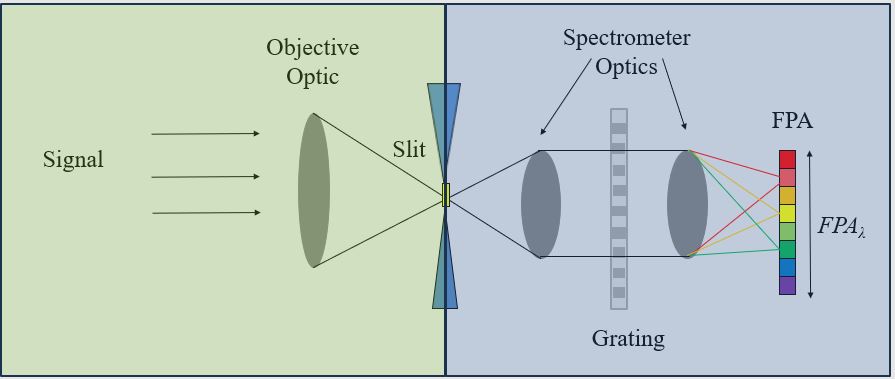
Two important characteristics of a hyperspectral imager (or any spectral imager for that matter) are its spatial and its spectral resolution. For line-scan instruments, one must consider both the along-track spatial resolution and the cross-track spatial resolution. The spectral resolution can be thought of as the spectral bandwidth of a spectral channel. Figure 2 shows a line-scan hyperspectral imaging spectrometer along the axis with dispersion. First consider the region with the green background. Here, the object of interest is imaged onto the slit plane at the interface between the green and blue regions. Only the portion of the intermediate image that overlaps with the slit is collected during a frame. In a high-resolution digital image, each pixel corresponds to a small region of the object. Similarly, for high spatial resolution with a hyperspectral imager, the slit likewise must be narrow to generate this high resolution. The spectral resolution is determined by the portion of the instrument shown with a blue background. Here one finds that the spectral resolution is dependent on the image size of the slit on the Focal Plane Array (FPA). By the way, this conclusion is also true for other spectrometer designs such as Offner or Dyson designs.
Two patented optical design approaches
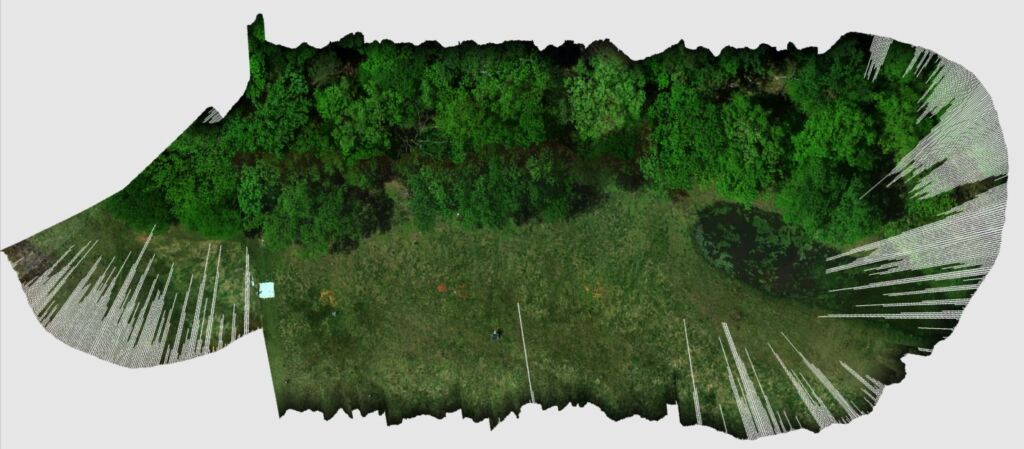
The fundamental conflict for hyperspectral imagers is that for high spatial resolution, which is needed for good imaging, one desires a narrow slit. However, to obtain large SNR a large bandwidth is desired and this requires a wide slit. In other words, the condition for good imaging counteracts with the condition for high throughput needed for large SNR. To resolve this conflict, one must introduce additional engineering parameters. Resonon has developed two patented optical design approaches that provide the needed engineering flexibility to trade spectral bandwidth for throughput without sacrificing spatial resolution. One approach, that is well proven, is suitable for far-field imaging. As an example, Figure 1 shows a Red-Green-Blue (RGB) image reconstruction of a forest edge, meadow, and small pond recorded with a Resonon imager that provides SNR similar to NASA’s AVIRIS system. These data were collected by the U.S. National Institute of Standards and Technology (NIST). The white gaps are artifacts from geo-correcting the data from a small drone. Resonon is currently working on a design suitable for near-field use, such as monitoring products on conveyor belts. This approach promises to substantially improve SNR as compared to conventional hyperspectral imaging at moderate cost and with low complexity, thereby potentially opening real-world commercial opportunities.